

Context Windows Explained: The Math, Limits, and Future of AI Memory
Why AI’s ability to “remember” is bounded by math—and what comes next

Introduction
The growth of Large Language Models (LLMs) has been defined as much by their memory as by their intelligence. When OpenAI extended GPT-4 Turbo to a 128K context window, and Anthropic announced Claude with 200K tokens, it sounded like a breakthrough: suddenly, these models could “read” hundreds of pages at once. Google’s Gemini 1.5 went further, claiming support for 1M tokens.
But here’s the catch: context windows are not infinite memory. They’re a mathematical construct, with practical limits in cost, latency, and accuracy. For AI leaders, product managers, and engineers, understanding how context windows actually work—and why they can’t scale indefinitely—is critical to building real-world AI systems.
This article breaks down:
How context windows are defined by the math of attention.
Why scaling them hits hard limits.
Engineering innovations that extend them.
Benchmarks of current long-context models.
The hybrid architectures that will shape the future of AI memory.
Strategic implications for product teams.
How Context Windows Work: The Math Behind Token Attention
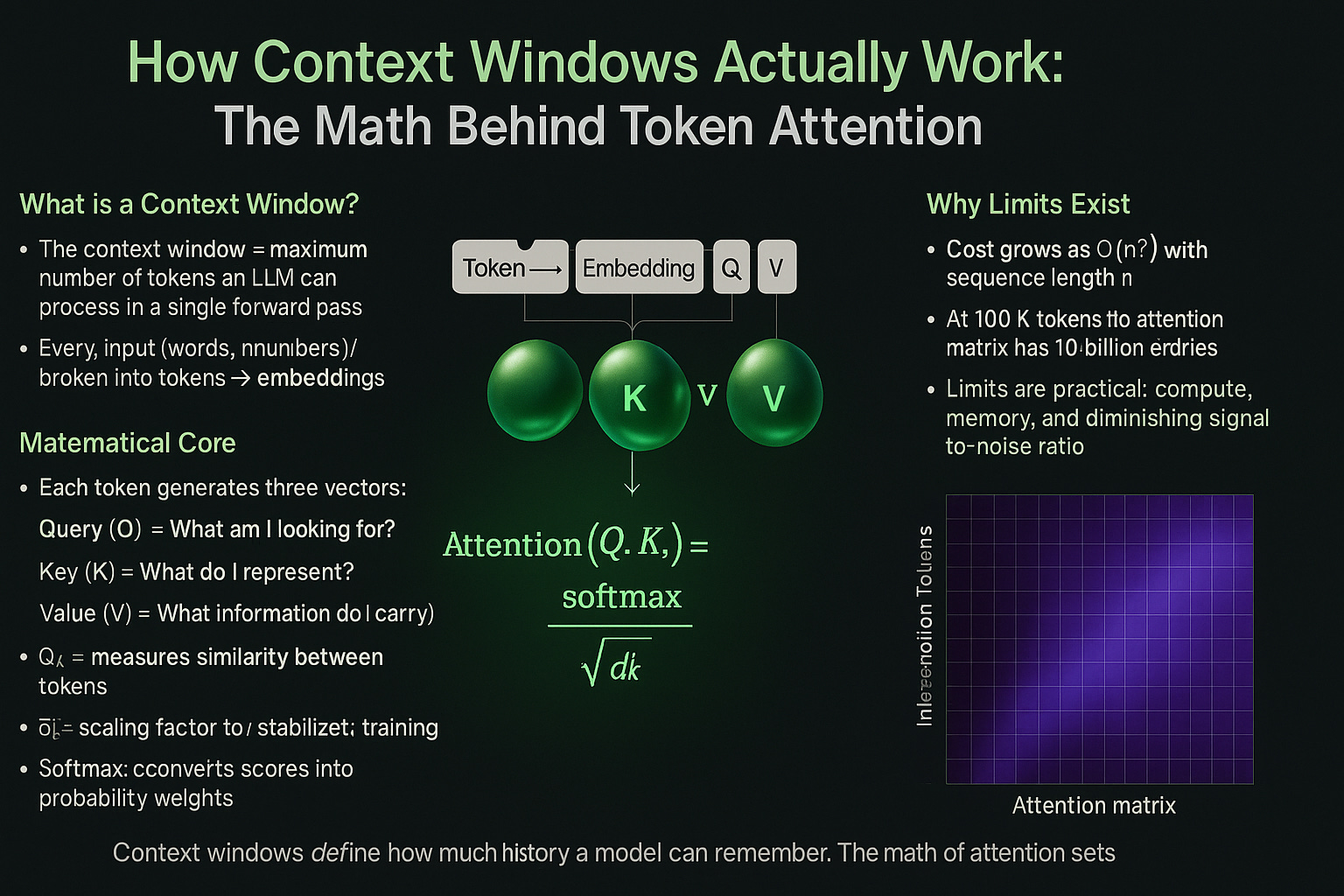
At the core of transformers lies the attention mechanism, which lets each token decide which prior tokens to focus on.
The process:
Inputs (words, symbols, numbers) are broken into tokens.
Each token generates three vectors:
Query (Q): “What am I looking for?”
Key (K): “What do I represent?”
Value (V): “What information do I carry?”
The fundamental equation:
Attention(Q,K,V)=softmax(QKTdk)VAttention(Q,K,V)=softmax(dkQKT)V
QKTQKT: similarity score between tokens.
dkdk: scaling factor.
Softmax: probability distribution across all prior tokens.
This design means every token compares itself to all other tokens. That’s powerful—but also computationally expensive.
Why Context Windows Hit Scaling Limits
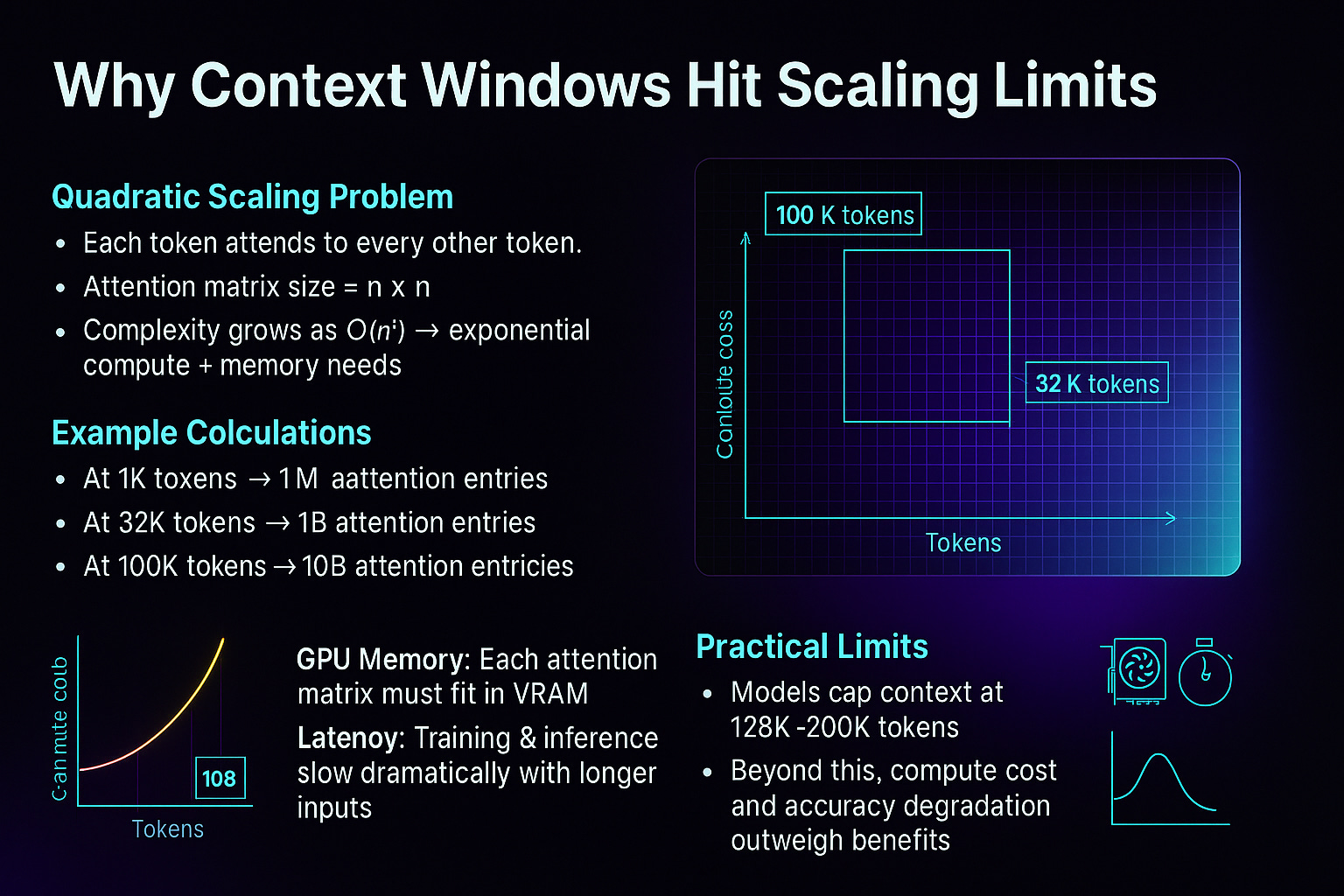
The attention matrix is quadratic:
For n tokens, attention requires n × n operations.
Complexity grows as O(n²).
Concrete examples:
1K tokens → 1M attention entries.
32K tokens → 1B entries.
100K tokens → 10B entries.
Implications:
GPU Memory: Each attention matrix must fit in VRAM.
Latency: Training and inference slow dramatically with longer sequences.
Noise: The longer the input, the harder it is for relevant tokens to stand out.
That’s why models cap context windows—even if you can technically extend them, the signal-to-noise ratio collapses.
Engineering Solutions to Extend Context Windows
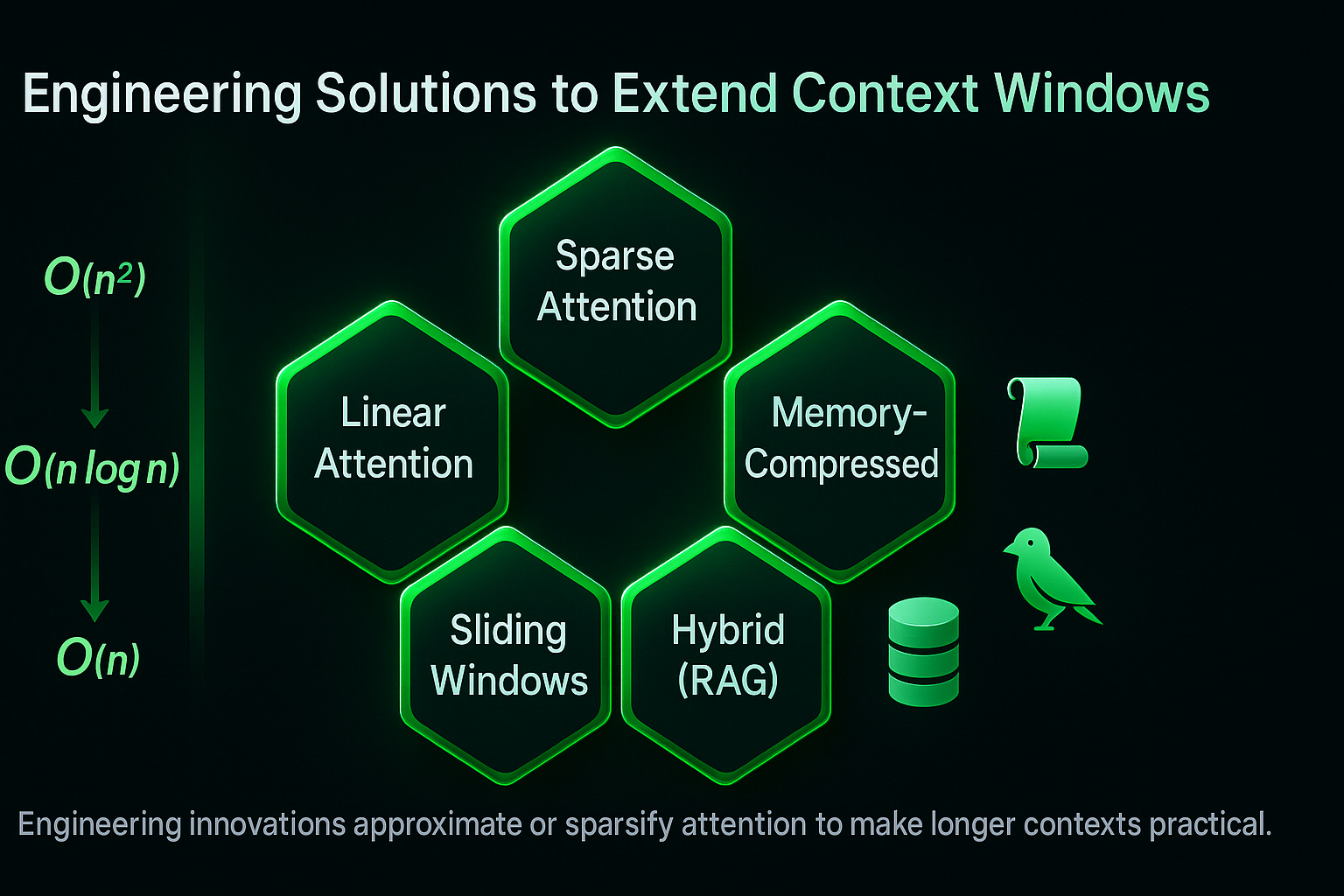
To overcome quadratic scaling, researchers have introduced approximations:
Sparse Attention → Attend to a subset of tokens. (Longformer, BigBird)
Linear Attention → Approximate softmax for O(n) complexity. (Performer)
Sliding / Chunked Windows → Break text into overlapping segments for local coherence.
Memory-Compressed Attention → Summarize past tokens into compressed representations. (Compressive Transformer)
Hybrid with Retrieval (RAG) → Fetch only relevant context chunks from external databases.
Each approach trades raw capacity for efficiency. But none fully solves the problem—hence the rise of hybrid architectures.
Benchmarking Long-Context Models
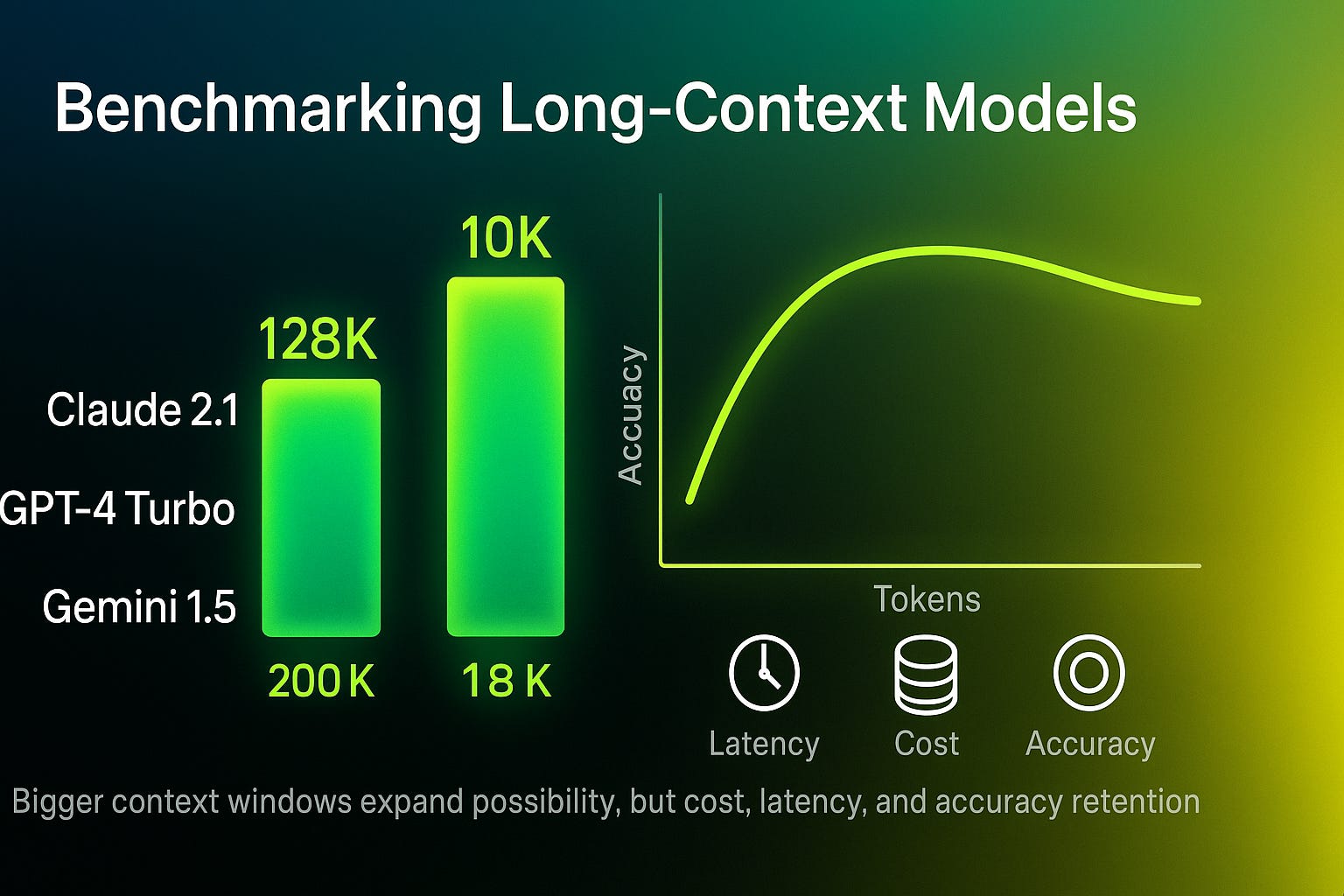
Current leaders:
Claude 2.1 – 200K tokens (~400 pages).
GPT-4 Turbo – 128K tokens (~300 pages).
Gemini 1.5 – 1M tokens (~2,000 pages).
Key findings:
Accuracy does not scale linearly. Beyond ~64K tokens, models often lose precision unless combined with RAG.
Latency and cost grow proportionally with tokens, not accuracy.
Compression strategies differ across providers, but none eliminate signal degradation entirely.
Implication: More tokens ≠ better reasoning. The bottleneck is not just scale, but relevance.
Beyond Context Windows: Hybrid Memory Architectures
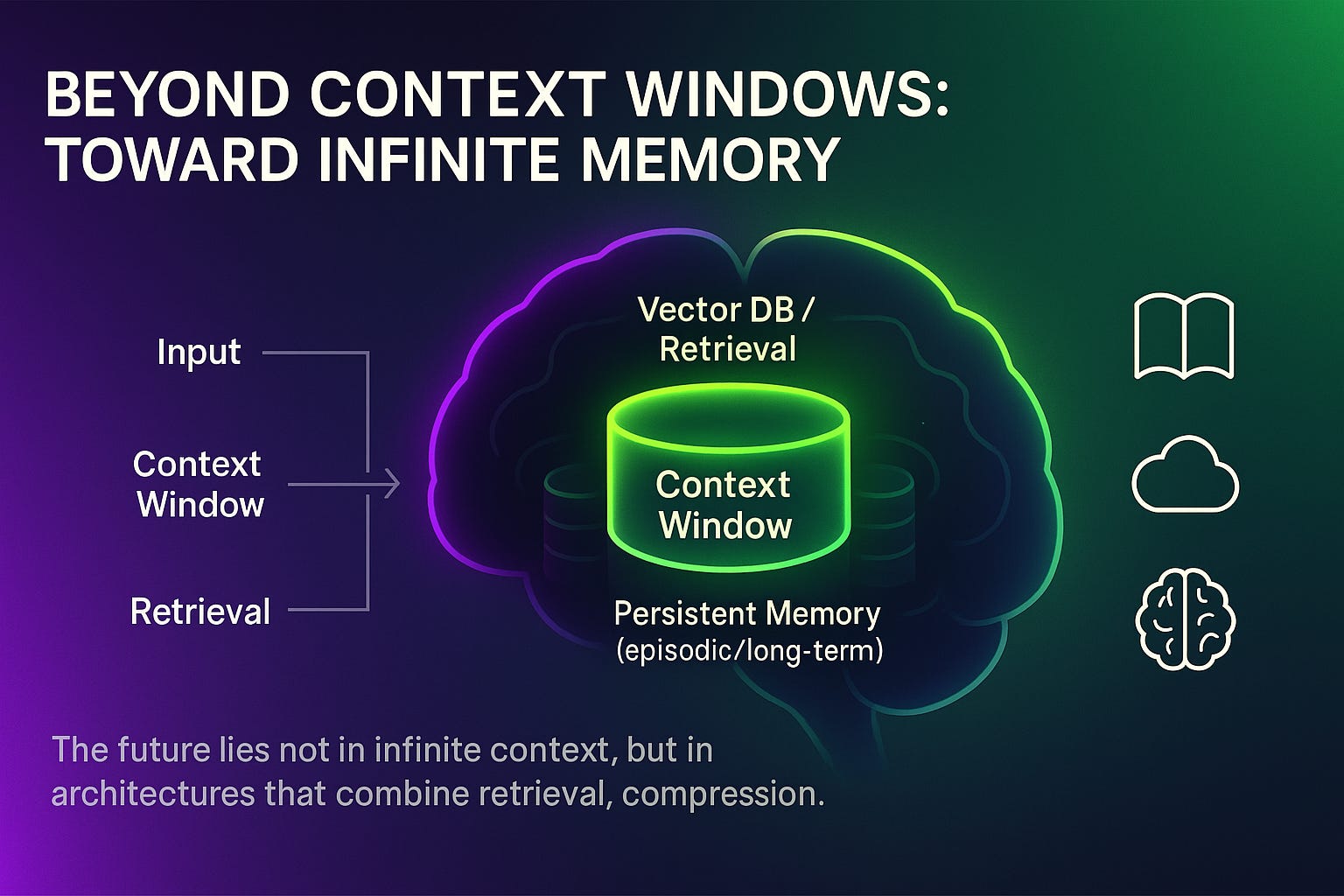
The future lies in hybrid memory stacks, not brute force context.
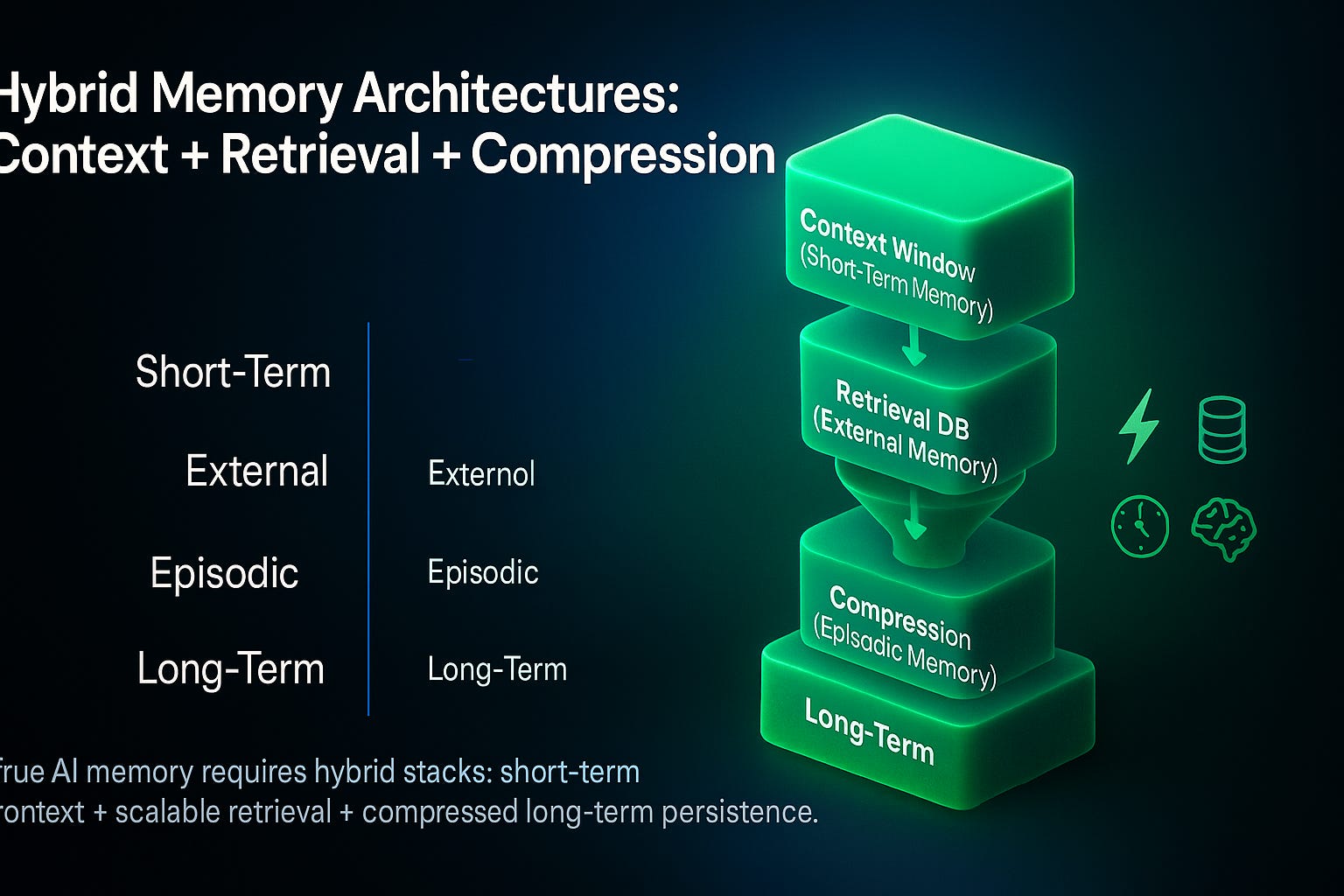
Four layers of memory:
Context Window (Short-Term Memory): Immediate active tokens.
Retrieval DB (External Memory): Vector database that fetches only what matters.
Compression Layer (Episodic Memory): Summaries of past interactions.
Persistent Memory (Long-Term): Knowledge retained across sessions.
Why it matters:
Keeps compute costs bounded.
Improves accuracy by filtering noise.
Enables agent-like continuity across conversations.
This is where retrieval-augmented generation (RAG) and episodic storage converge—creating AI systems that remember without exploding compute budgets.
Strategic Lessons for Product Leaders & AI Teams
For AI Engineers
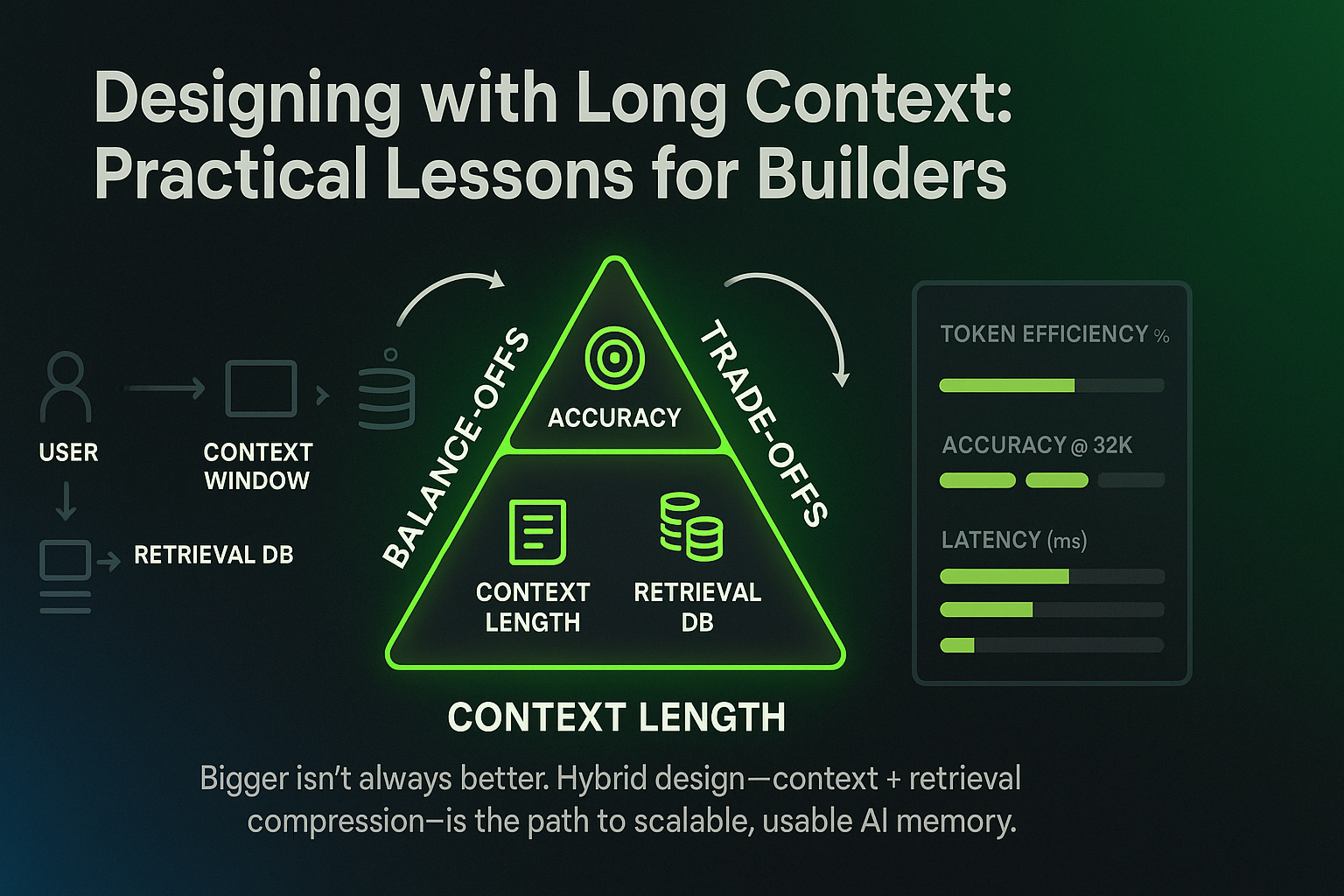
Don’t assume bigger is better—test for accuracy retention.
Benchmark efficiency: % of tokens that actually impact output.
Use hybrid retrieval when dealing with large corpora.
For Product Managers
Match model context size to use case:
Customer service bots → 8K–32K.
Contract review, codebase QA → 100K+.
Monitor trade-offs: cost vs latency vs accuracy.
Design UX expectations—users assume long memory, but models don’t “remember” by default.
For AI Leaders
Long context is not a silver bullet.
The future will come from persistent agent memory—combining context, retrieval, and compression into a unified system.
This architecture is what will unlock scalable enterprise AI.
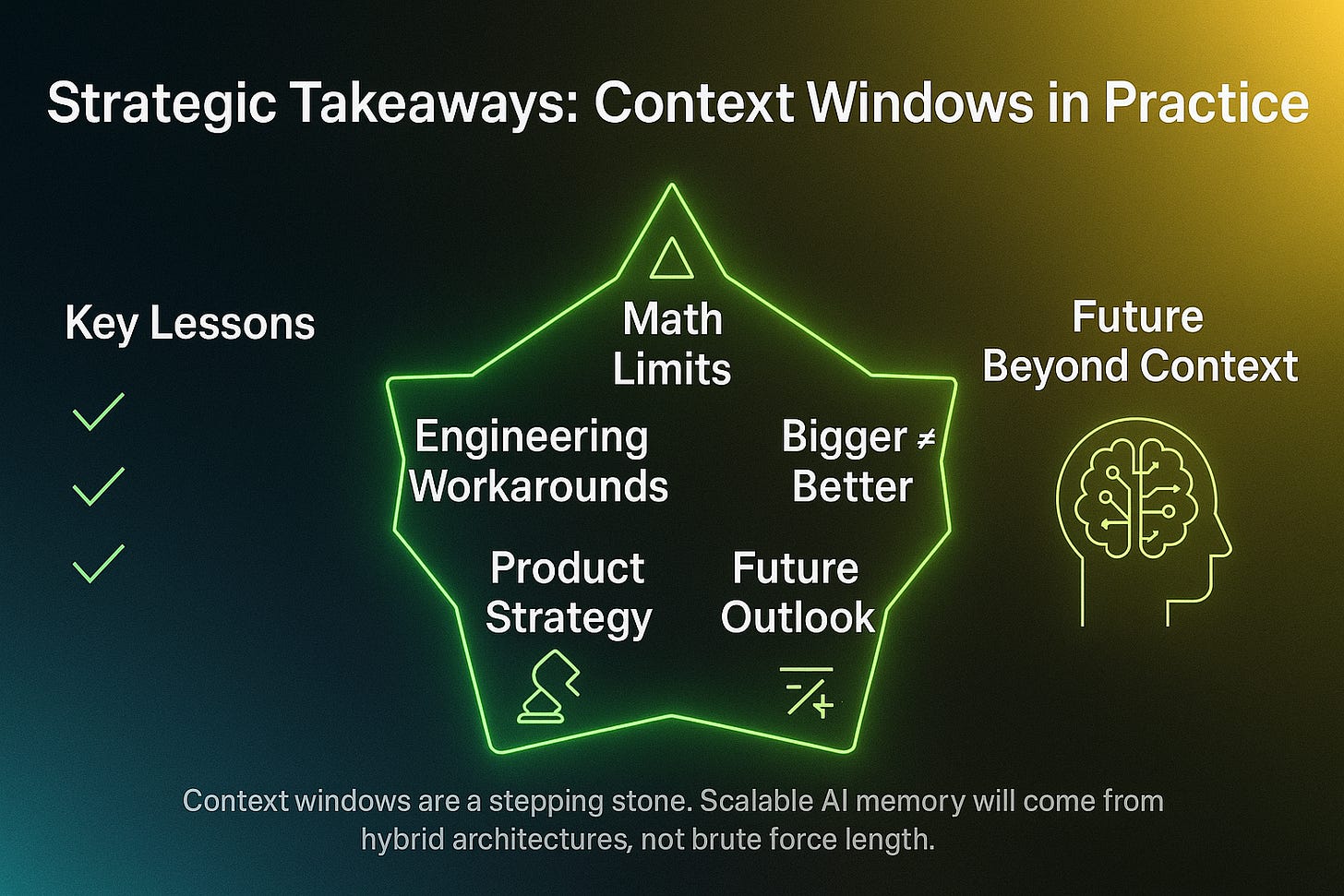
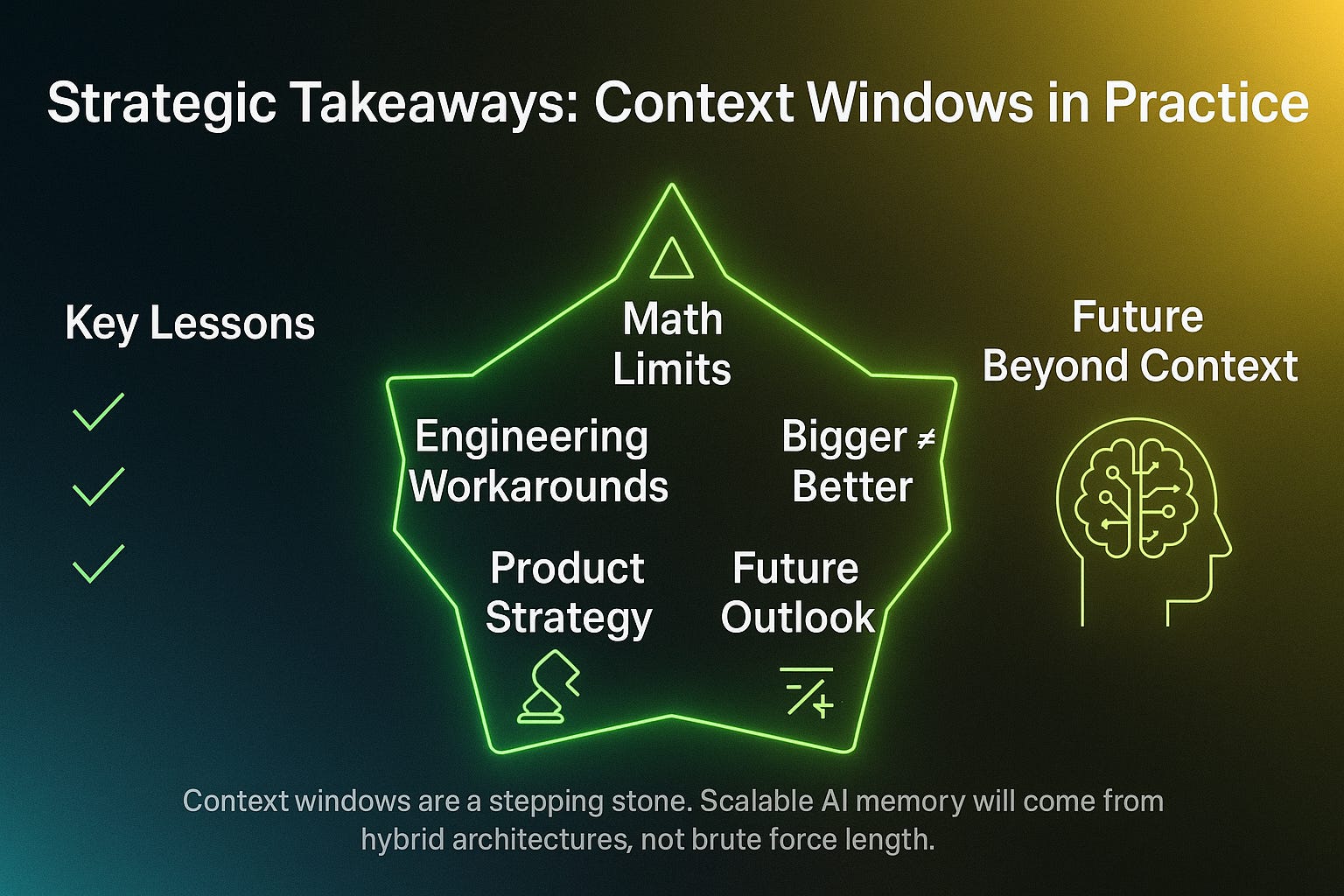
Strategic Takeaways
References & Further Reading
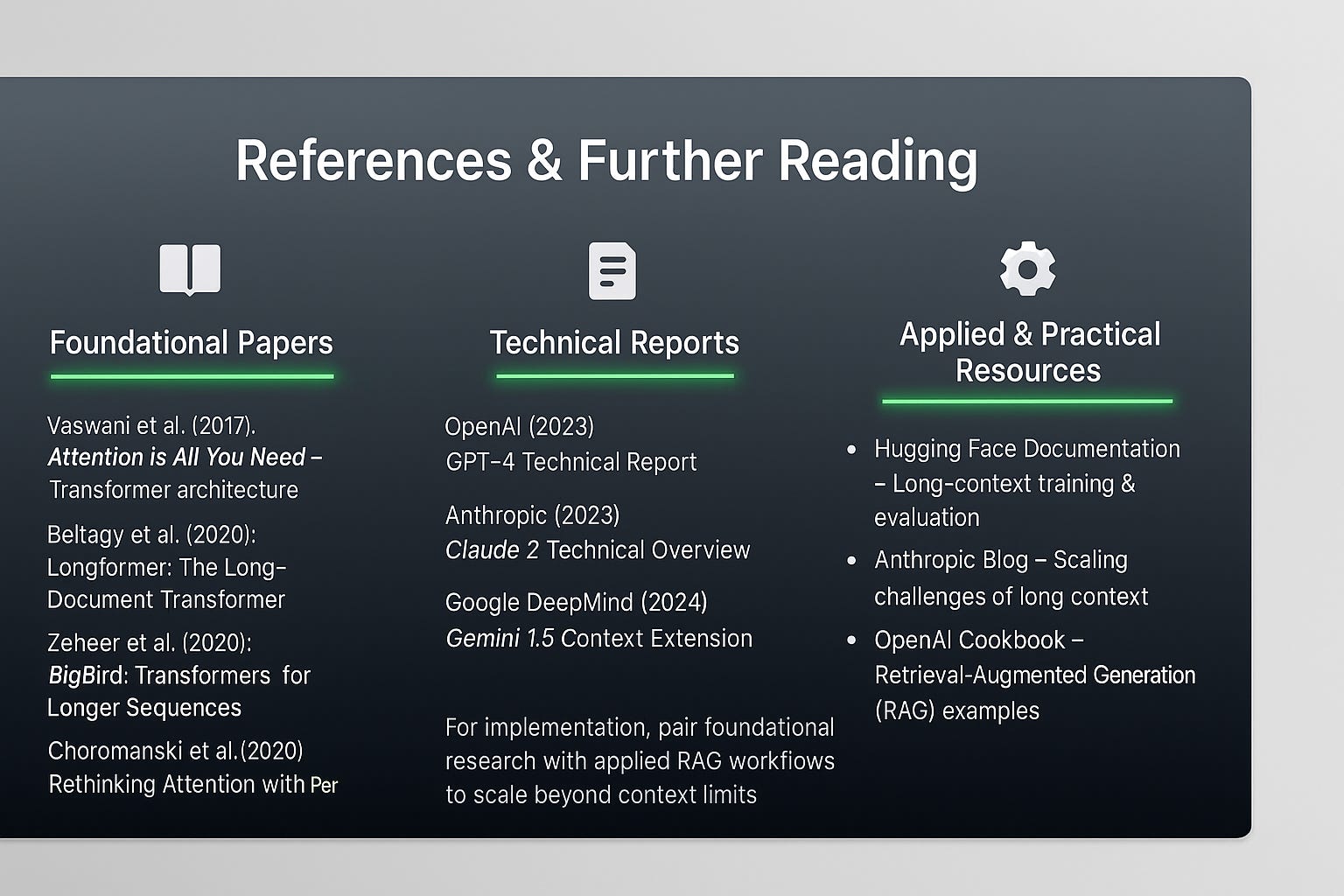
Papers
Vaswani et al. (2017). Attention is All You Need.
Beltagy et al. (2020). Longformer.
Zaheer et al. (2020). BigBird.
Choromanski et al. (2020). Performers.
Reports
OpenAI (2023). GPT-4 Technical Report.
Anthropic (2023). Claude 2 Overview.
Google DeepMind (2024). Gemini 1.5 Context Extension.
Practical Guides
Hugging Face: Long-context training resources.
Anthropic blog on context scaling.
OpenAI Cookbook: Retrieval-Augmented Generation (RAG).
Closing Thought
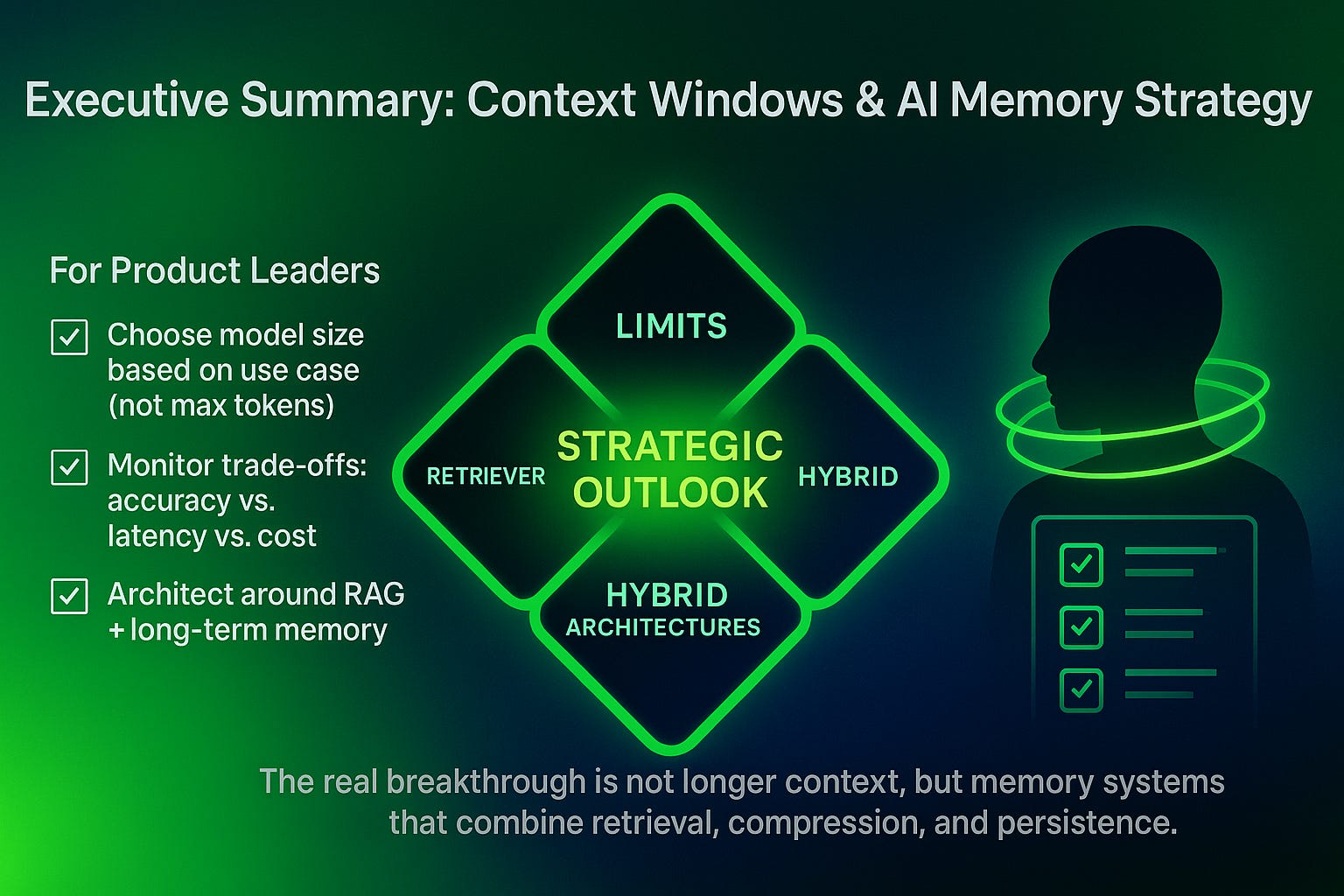
The race for ever-larger context windows will continue—but it’s not where the real breakthrough lies. The next frontier is hybrid AI memory: architectures that blend short-term context, retrieval databases, episodic compression, and long-term persistence.
For AI leaders, this means shifting the focus from “How big is the context window?” to “How efficiently does the system use memory?”
That is the real step from language models to reasoning agents.