

Multi-Agent Workflows: The Future of Data Integration
From brittle ETL pipelines to adaptive, autonomous agent networks — how enterprises can unlock real-time, trusted intelligence.

The Data Integration Crisis
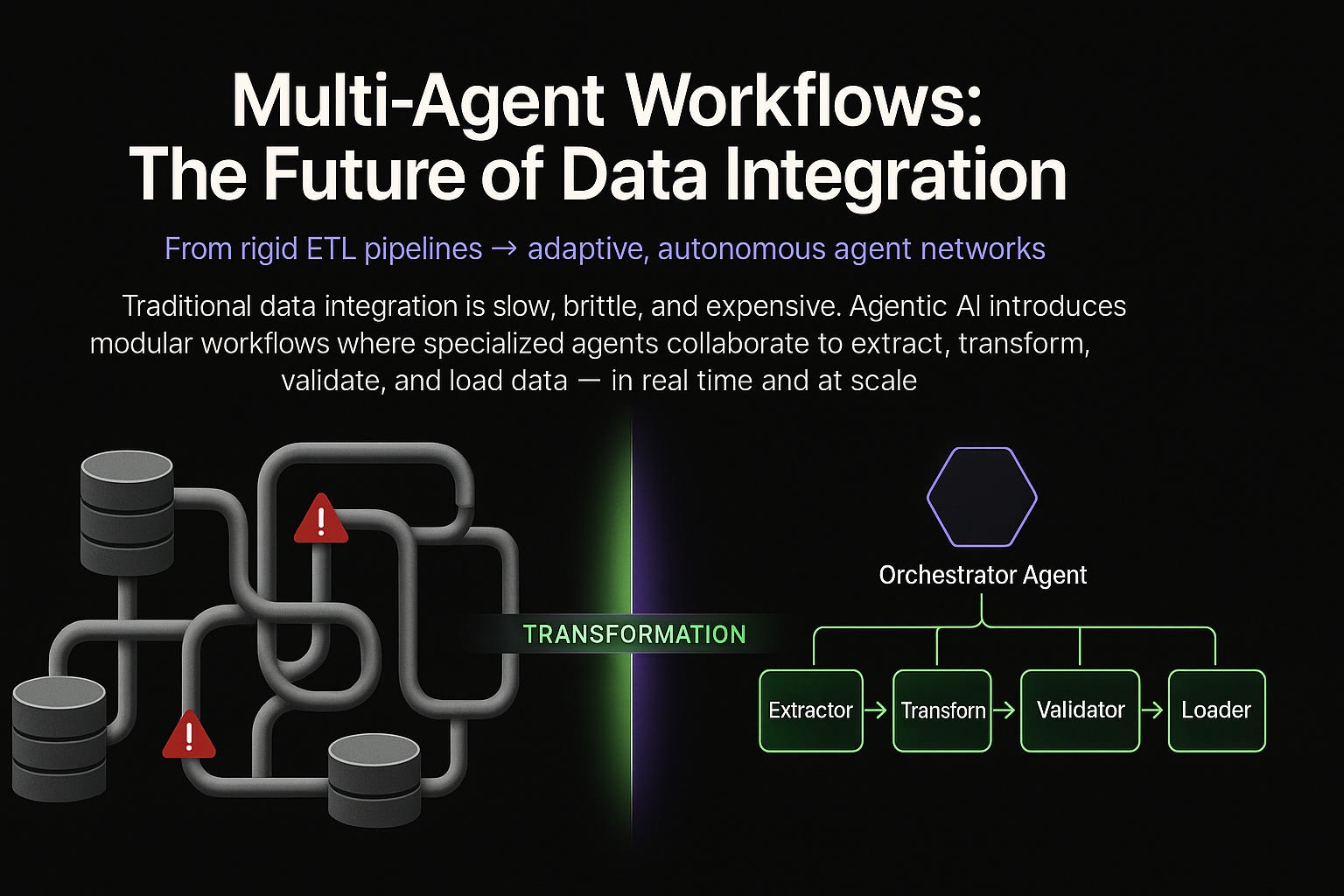
Enterprises today are swimming in data — but much of it remains locked in silos. IDC projects that by 2025, global data volume will reach 175 zettabytes, with over 80% of enterprise data unstructured. Yet, most organizations still rely on traditional ETL (Extract, Transform, Load) pipelines that are:
Rigid: built for static schemas, unable to adapt to fast-changing sources.
Costly: Gartner estimates integration consumes 60% of data engineering budgets.
Error-prone: manual SQL scripts and brittle workflows fail silently.
Slow: batch jobs delay insights by days or weeks.
As a result, companies suffer from delayed decisions, rising costs, and missed opportunities.
The Agentic AI Paradigm
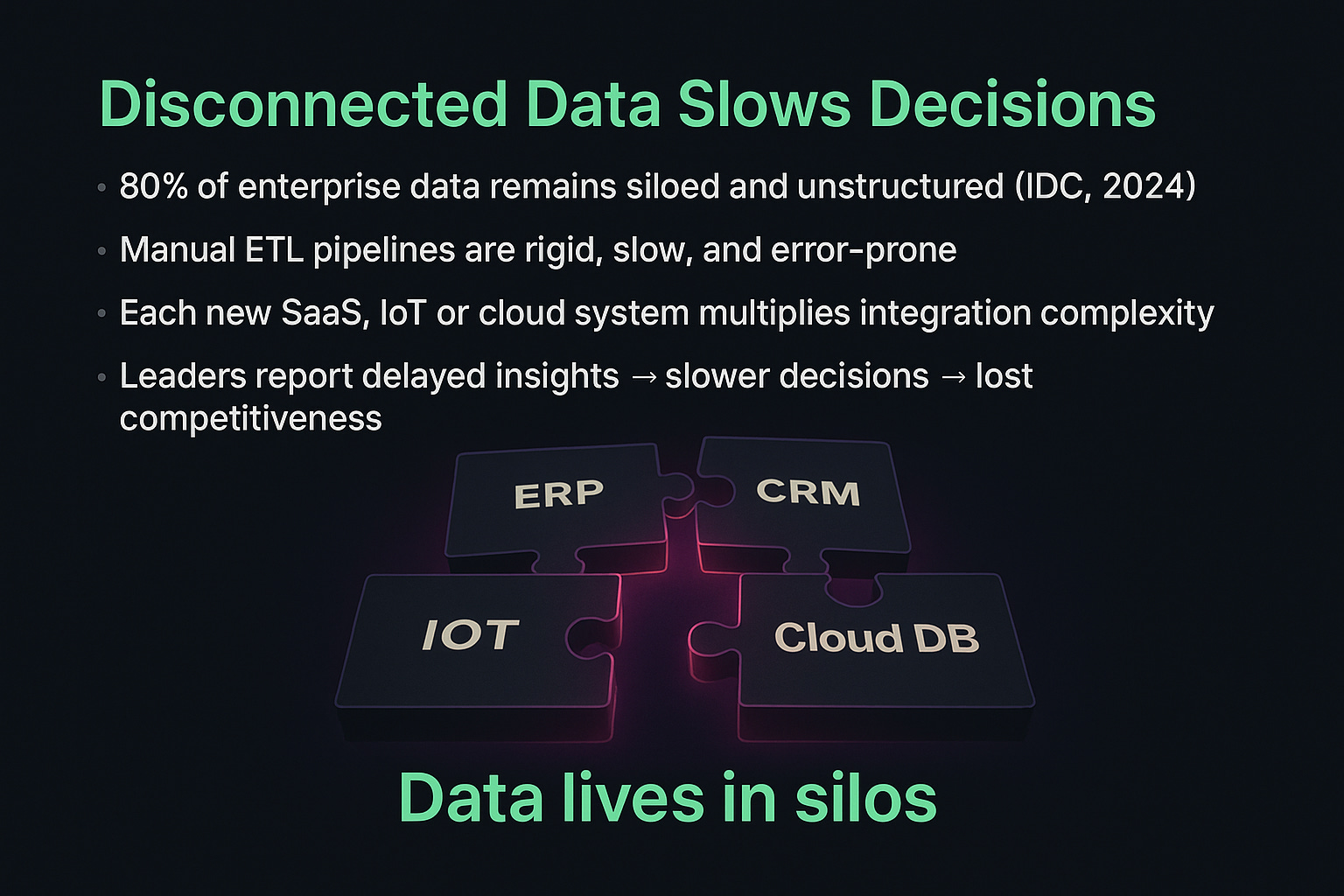
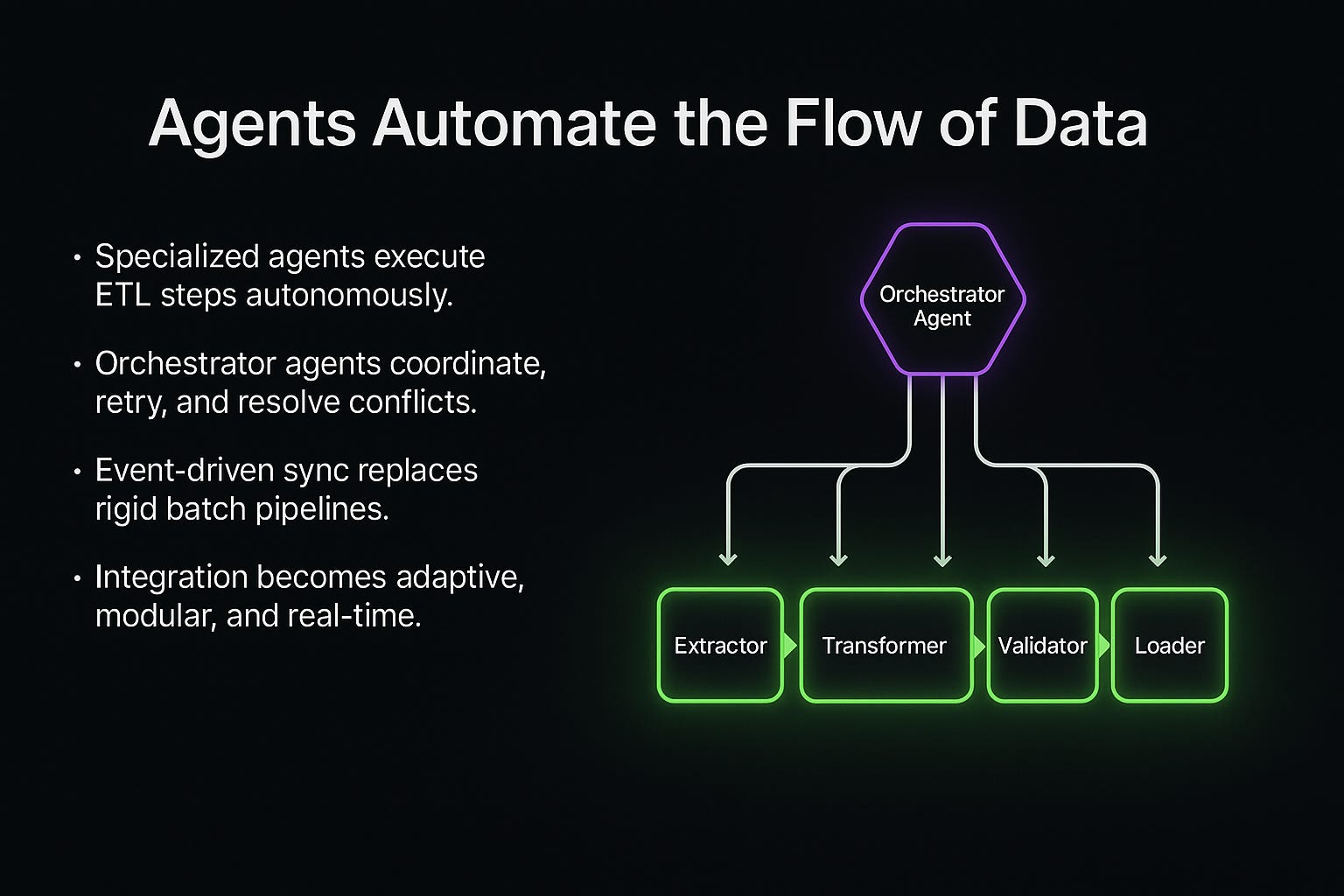
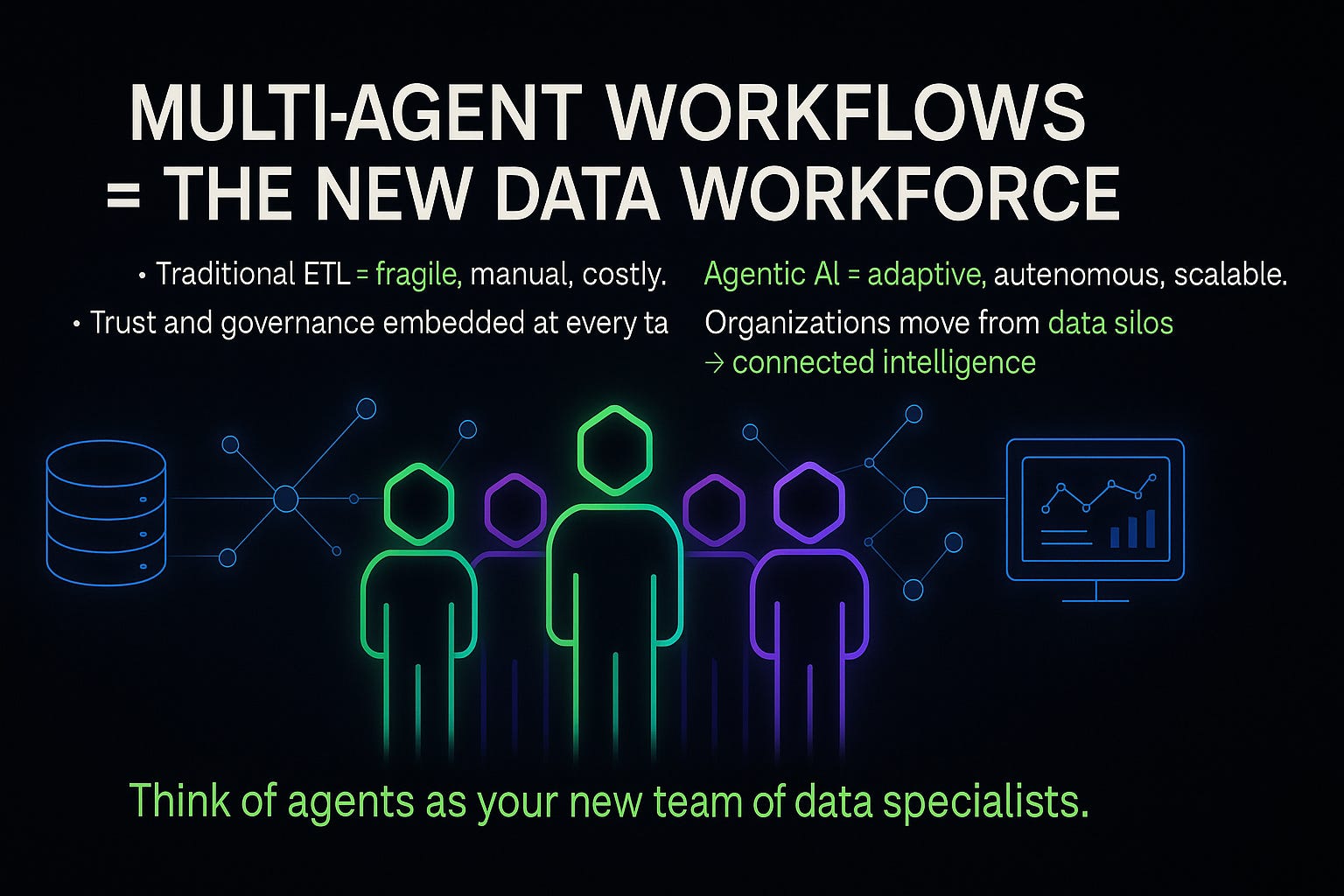
Multi-agent AI offers a breakthrough: autonomous digital workers that can extract, clean, validate, and integrate data continuously and adaptively.
Instead of a single rigid pipeline, organizations deploy a network of specialized agents, each with a clear role:
Extractor Agents → connect to structured/unstructured sources.
Transformer Agents → normalize and enrich data.
Validator Agents → detect anomalies, missing values, and duplicates.
Loader Agents → push data into warehouses, lakes, and APIs.
Orchestrator Agents → coordinate workflows, resolve conflicts, and manage retries.
These agents communicate via emerging standards like:
JSON Schema → shared contract for data structures.
MCP (Model Context Protocol) → ensuring agents and LLMs exchange data context consistently.
A2A (Agent-to-Agent Protocols) → enabling negotiation and delegation between agents.
This creates real-time, event-driven pipelines that self-adjust as new sources appear.
Architecture of Multi-Agent Workflows
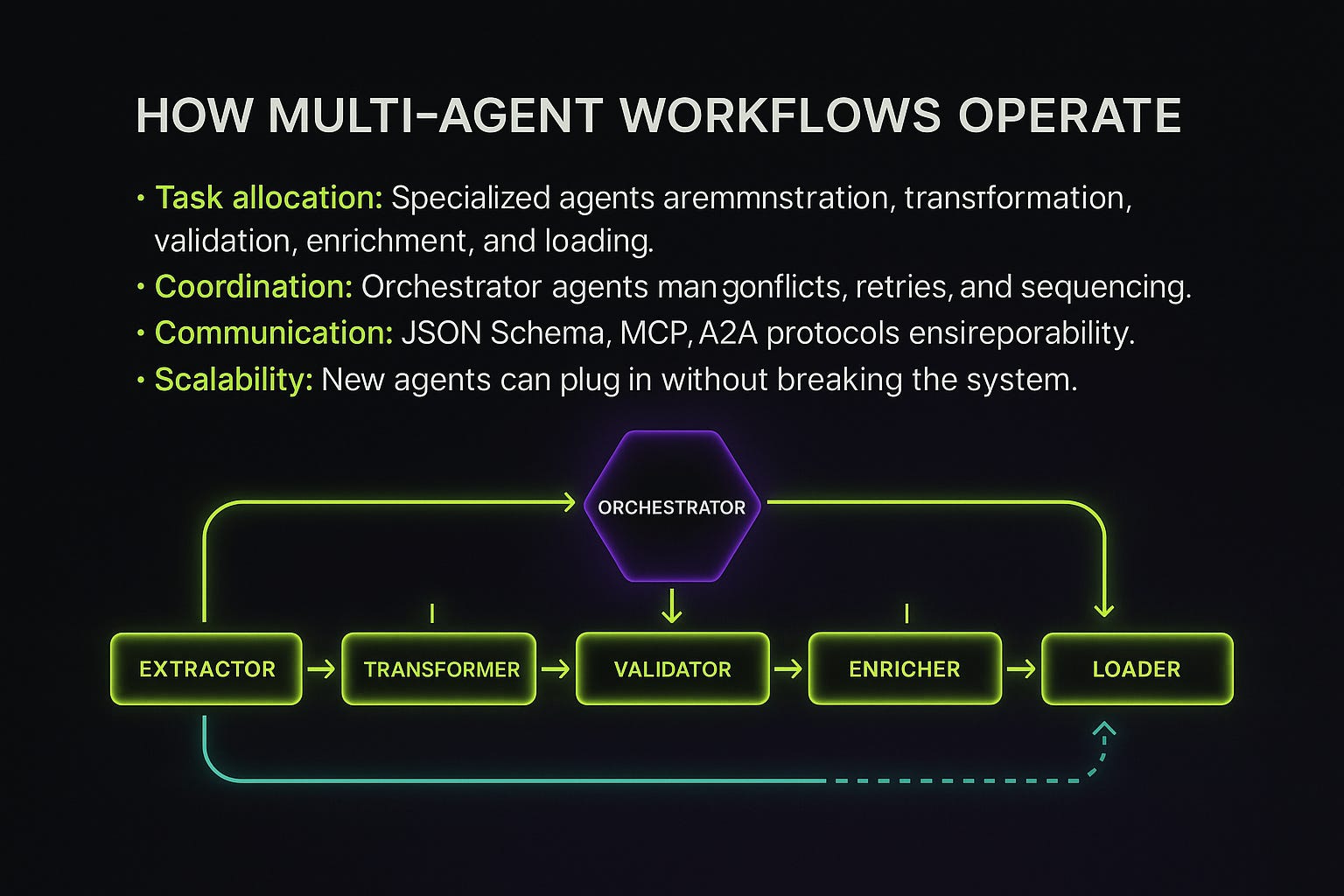
The architecture resembles a modular factory line:
Task Allocation: each agent specializes in a micro-task.
Coordination: orchestrators assign work, resolve errors.
Communication: standard protocols ensure interoperability.
Scalability: new agents can plug in without breaking the system.
Think of it as replacing a single conveyor belt with a team of skilled workers — each agent does one thing well, and the orchestrator supervises.
Trust and Governance by Design
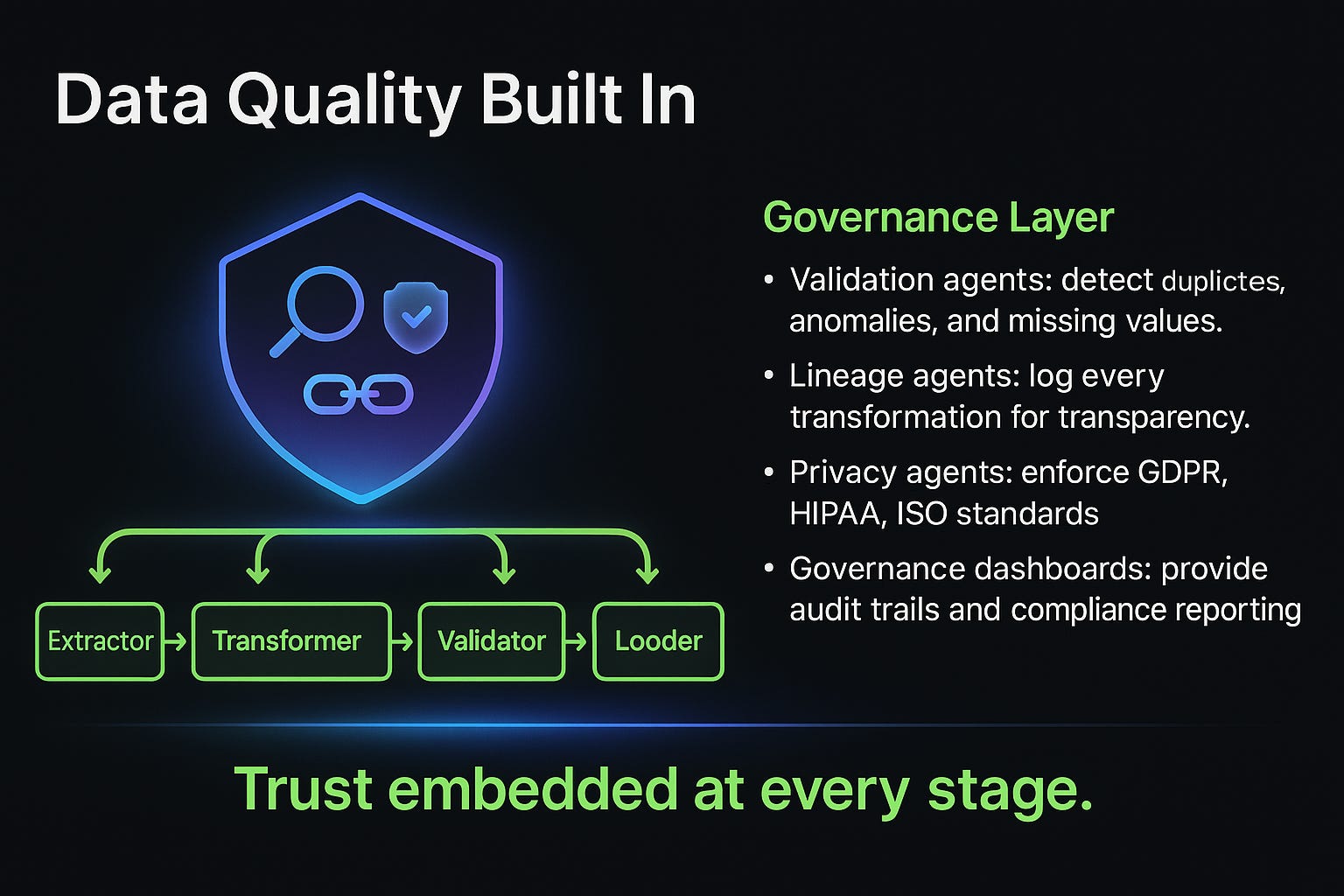
One of the critical flaws of legacy ETL is lack of transparency. Multi-agent workflows embed trust layers:
Lineage Agents: track every transformation for full auditability.
Privacy Agents: enforce GDPR, HIPAA, ISO standards with privacy-preserving AI.
Compliance Dashboards: allow regulators and auditors to see what data moved, when, and how.
Validation Agents: constantly test for anomalies, drift, and data poisoning.
McKinsey (2025) highlights that trust in AI adoption hinges on explainability and auditability — multi-agent systems make this possible.
Industry Use Cases
Multi-agent data integration is not theoretical — it’s already reshaping industries:
Supply Chain
Amazon and Maersk deploy agents to unify supplier databases, IoT shipping logs, and customs data.
Benefits: real-time demand sensing, fewer stockouts, reduced logistics costs.
Healthcare
Mayo Clinic pilots agents to integrate EHRs, lab tests, and imaging data.
Benefits: unified patient view, accelerated research, and compliance with HIPAA.
Finance
JPMorgan uses agentic reconciliation agents for fraud detection and real-time trading risk analysis.
Benefits: faster settlements, lower fraud losses.
Energy & Construction
Fugro integrates geodata, BIM models, and asset registries using agent workflows.
Benefits: improved asset management, predictive maintenance, offshore wind planning.
Measurable Business Value
Case studies show clear ROI:
Snowflake (2024): integration time cut by 60%.
Accenture (2025): automation reduces costs by 40%.
Deloitte (2024): real-time validation doubles accuracy in data quality.
KPIs to track:
Time-to-integration (weeks → days).
Error rates and anomalies detected.
Cost per data pipeline.
Latency from event → insight.
Adoption Roadmap
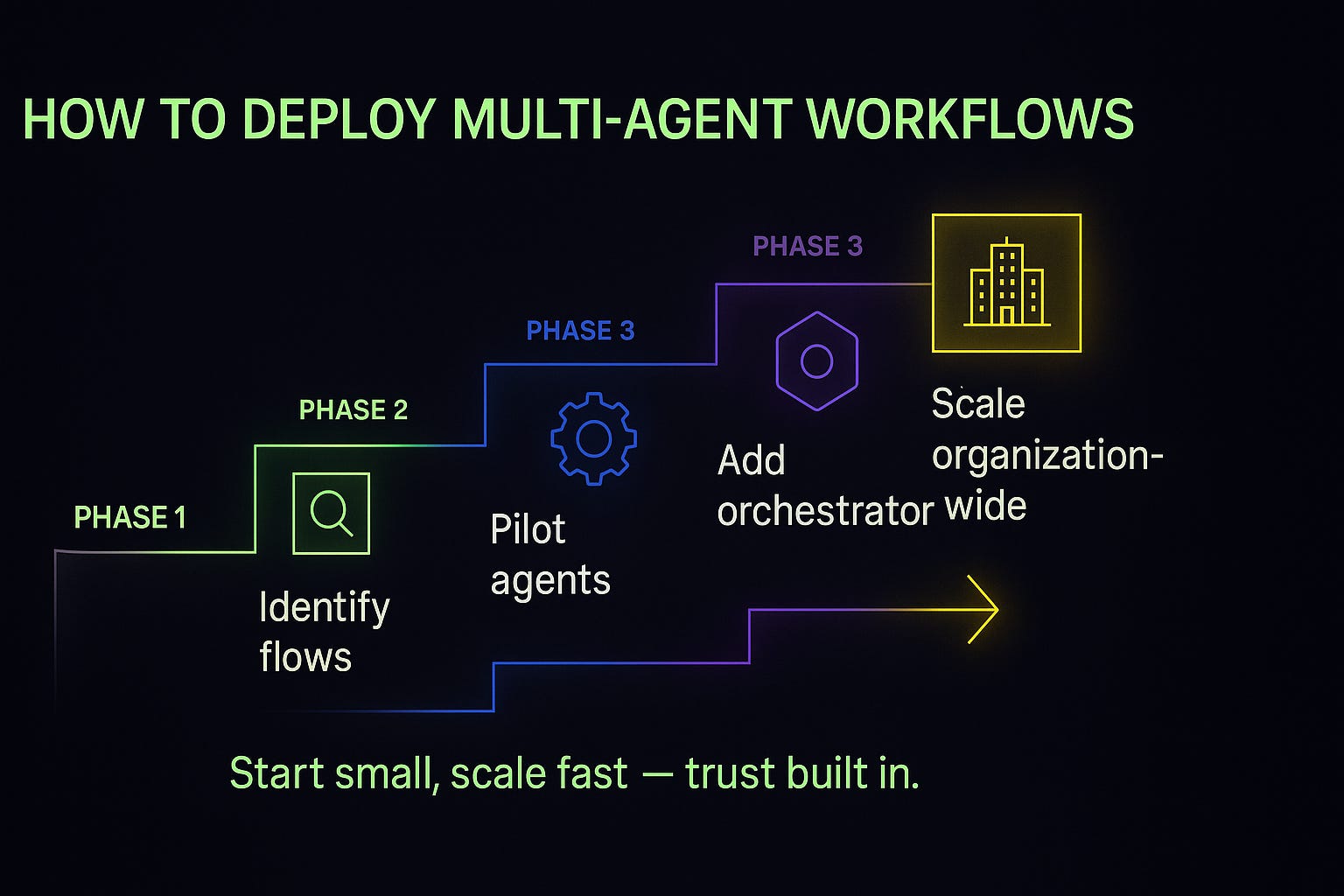
How to get started:
Phase 1: Diagnose & Prioritize
Map current data flows.
Identify bottlenecks with highest business value.
Phase 2: Pilot Agents
Deploy extractor + validator agents for a single flow (e.g., CRM ↔ ERP).
Measure baseline metrics.
Phase 3: Add Orchestration & Governance
Introduce orchestrator agents.
Layer in governance dashboards and lineage tracking.
Phase 4: Scale Enterprise-Wide
Expand across departments.
Connect cross-enterprise ecosystems with privacy-preserving AI.
The Next Frontier
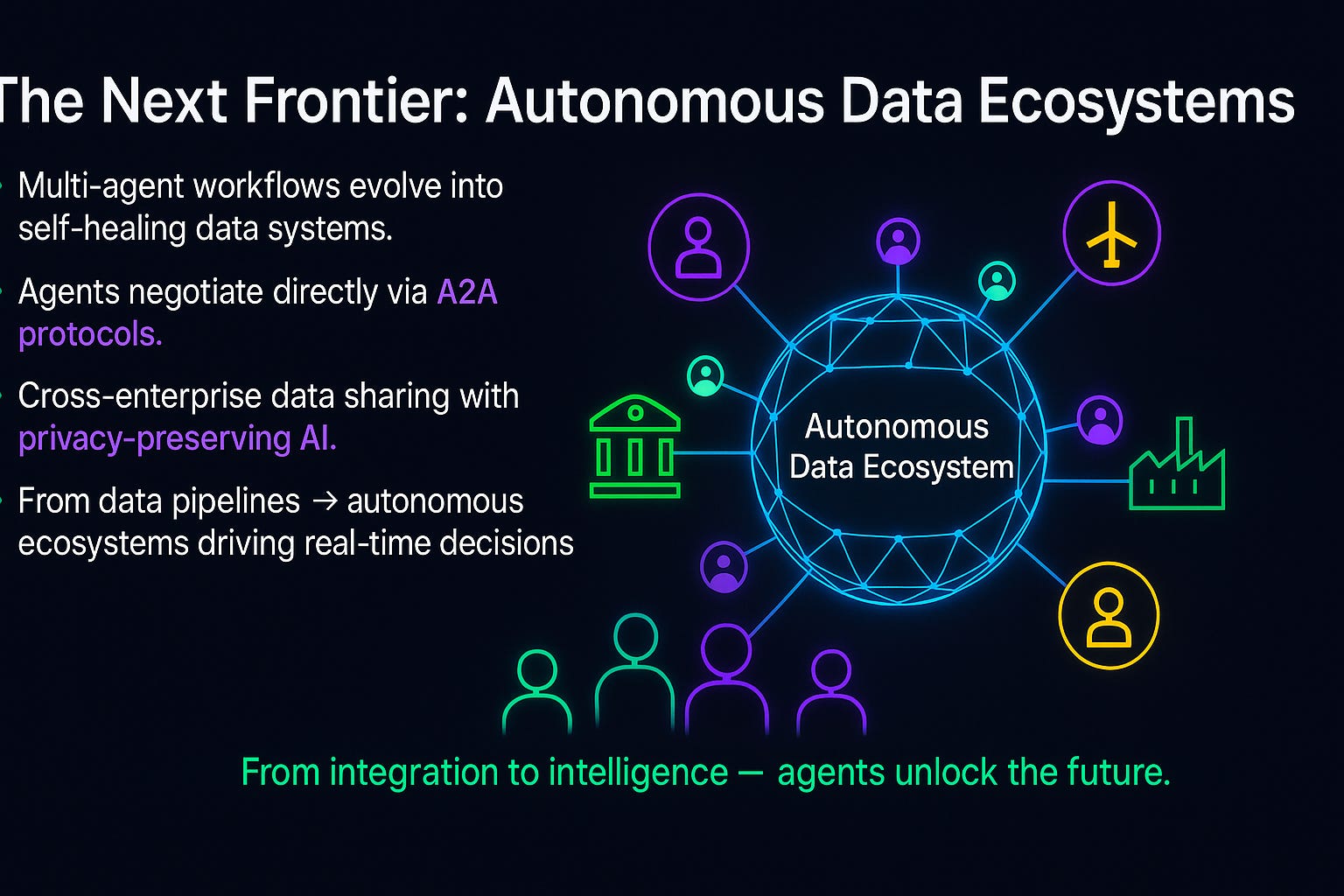
Multi-agent workflows are only the beginning. The evolution points toward autonomous data ecosystems:
Self-healing data systems → pipelines that fix schema mismatches automatically.
Agent-to-Agent negotiations → agents dynamically decide optimal integration routes.
Federated ecosystems → enterprises share insights without sharing raw data.
Autonomous intelligence loops → data not just integrated, but continuously optimized for decision-making.
The future of integration is not ETL. It’s AI agents negotiating, validating, and sharing data in real-time ecosystems.
References & Resources
Closing Thought
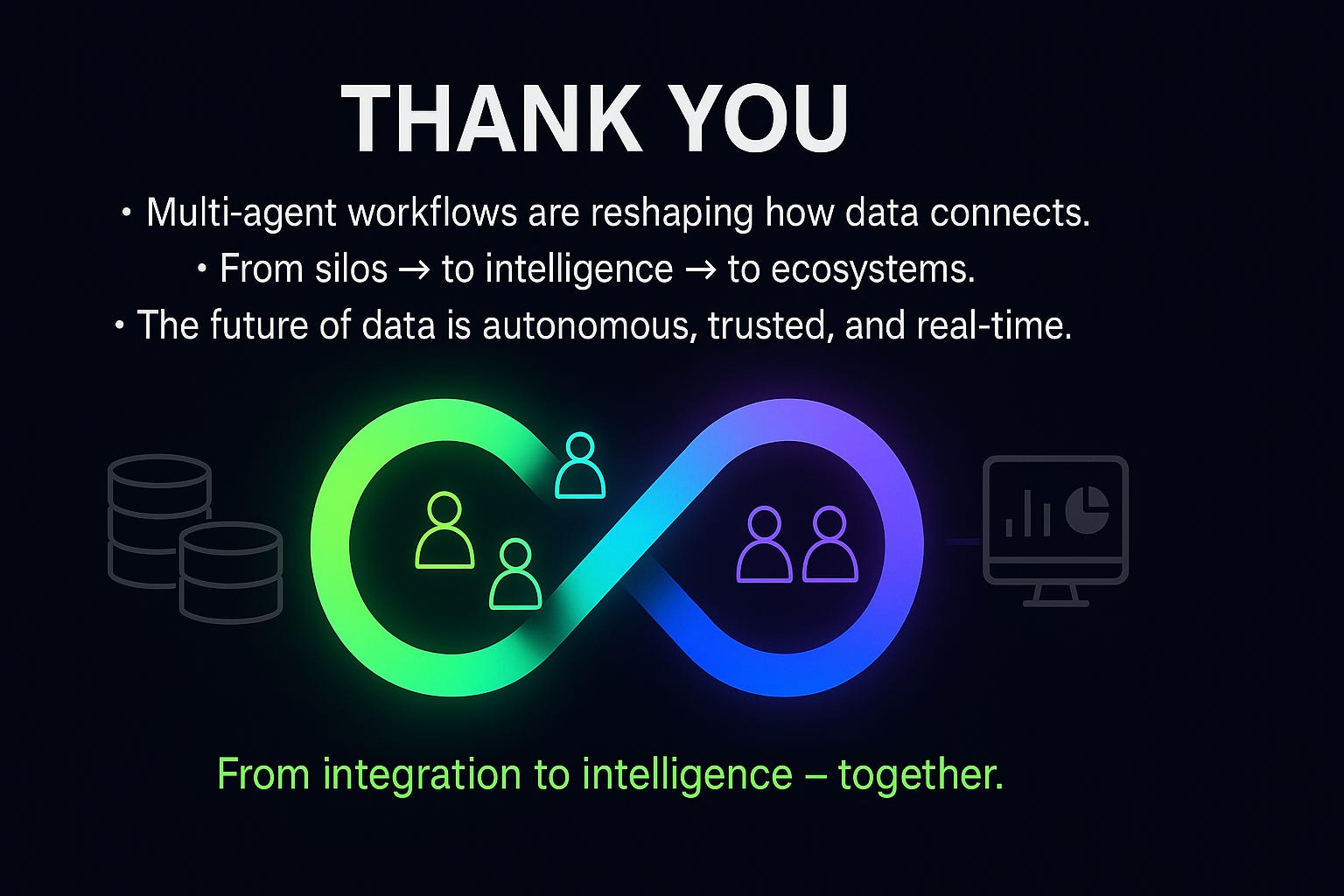
Think of multi-agent workflows as your new team of digital data specialists: extractors, transformers, validators, and orchestrators — working tirelessly, around the clock, with transparency and trust.
For organizations stuck in data silos, this is not just an upgrade.
It’s a leap from integration → intelligence → autonomy.