

Semantic Kernel: Orchestrating the Future of Enterprise AI
How Microsoft’s open-source orchestration SDK is quietly becoming the operating system for enterprise AI agents

Introduction: Why LLMs Alone Are Not Enough
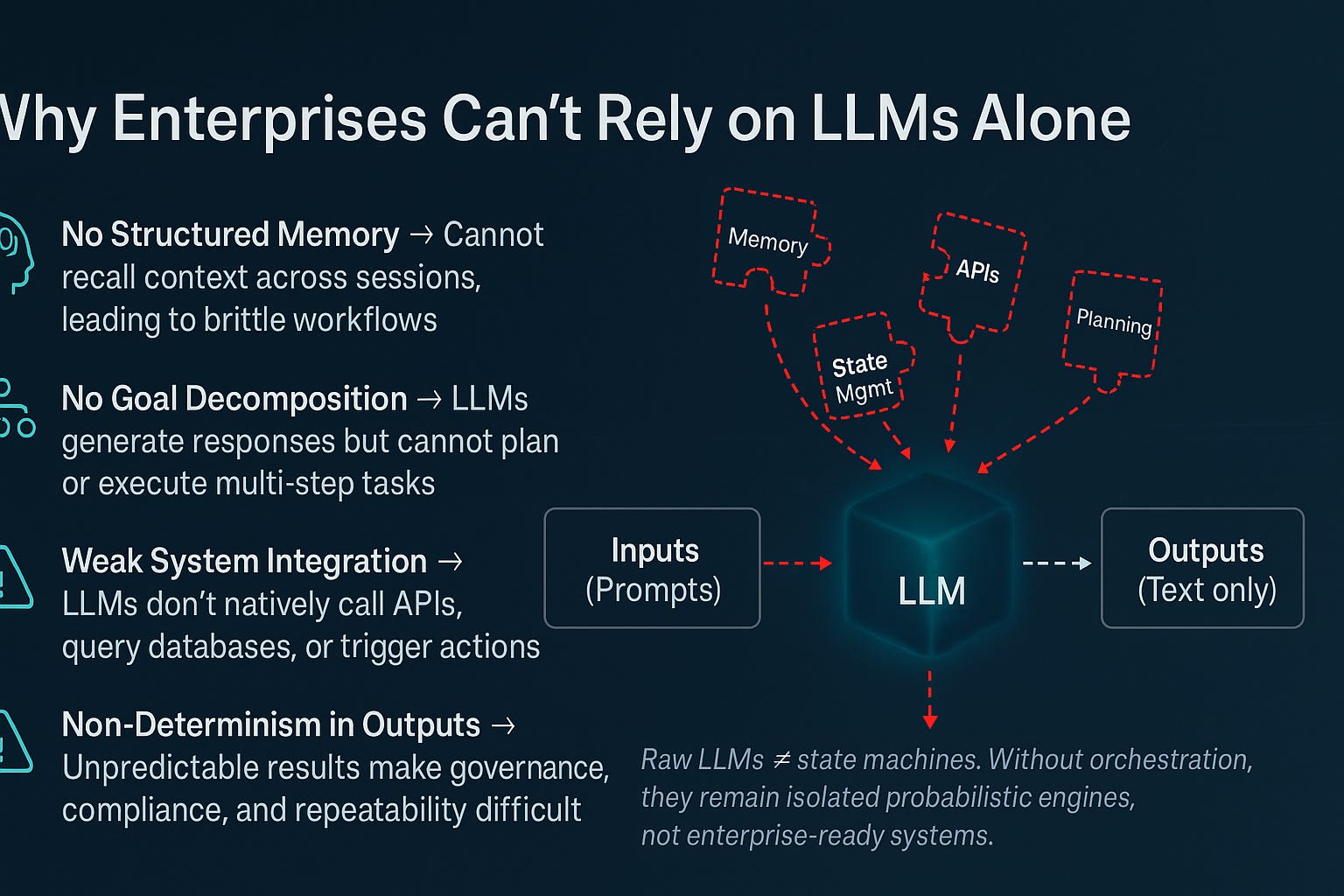
Large Language Models (LLMs) have proven their power: they can generate human-like text, summarize documents, answer questions, and even write code. But enterprises quickly run into limitations when trying to productionize them:
No Memory → LLMs don’t recall across sessions.
No Goal Decomposition → They can’t plan multi-step workflows.
Weak Integration → Out-of-the-box, they don’t connect to APIs or databases.
Non-Determinism → Their outputs are probabilistic, making governance difficult.
The result? Chatbots that demo well, but fall apart in production.
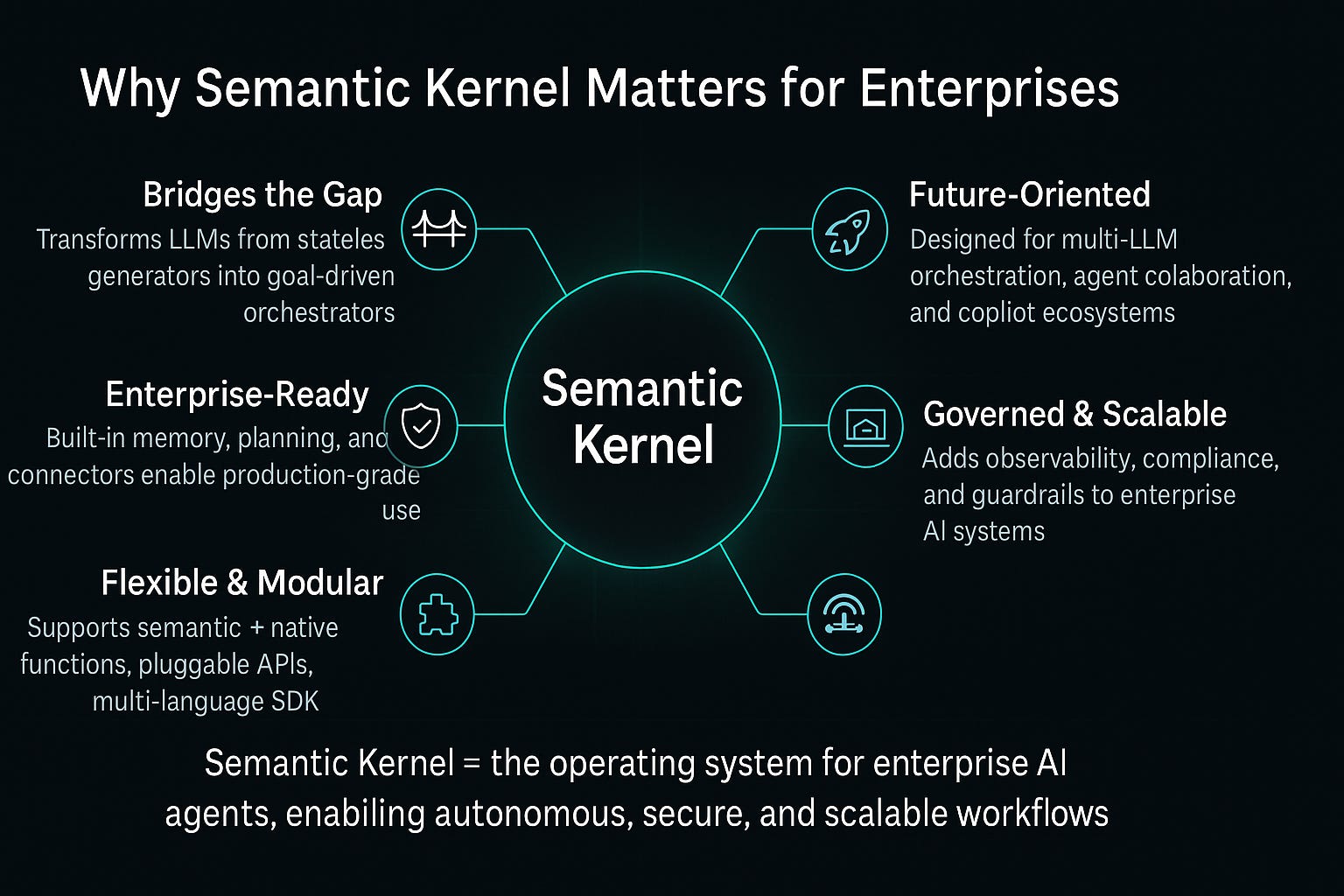
This is where Semantic Kernel (SK) comes in — Microsoft’s open-source SDK that turns LLMs into programmable, orchestrated, and stateful agents.
What is Semantic Kernel?
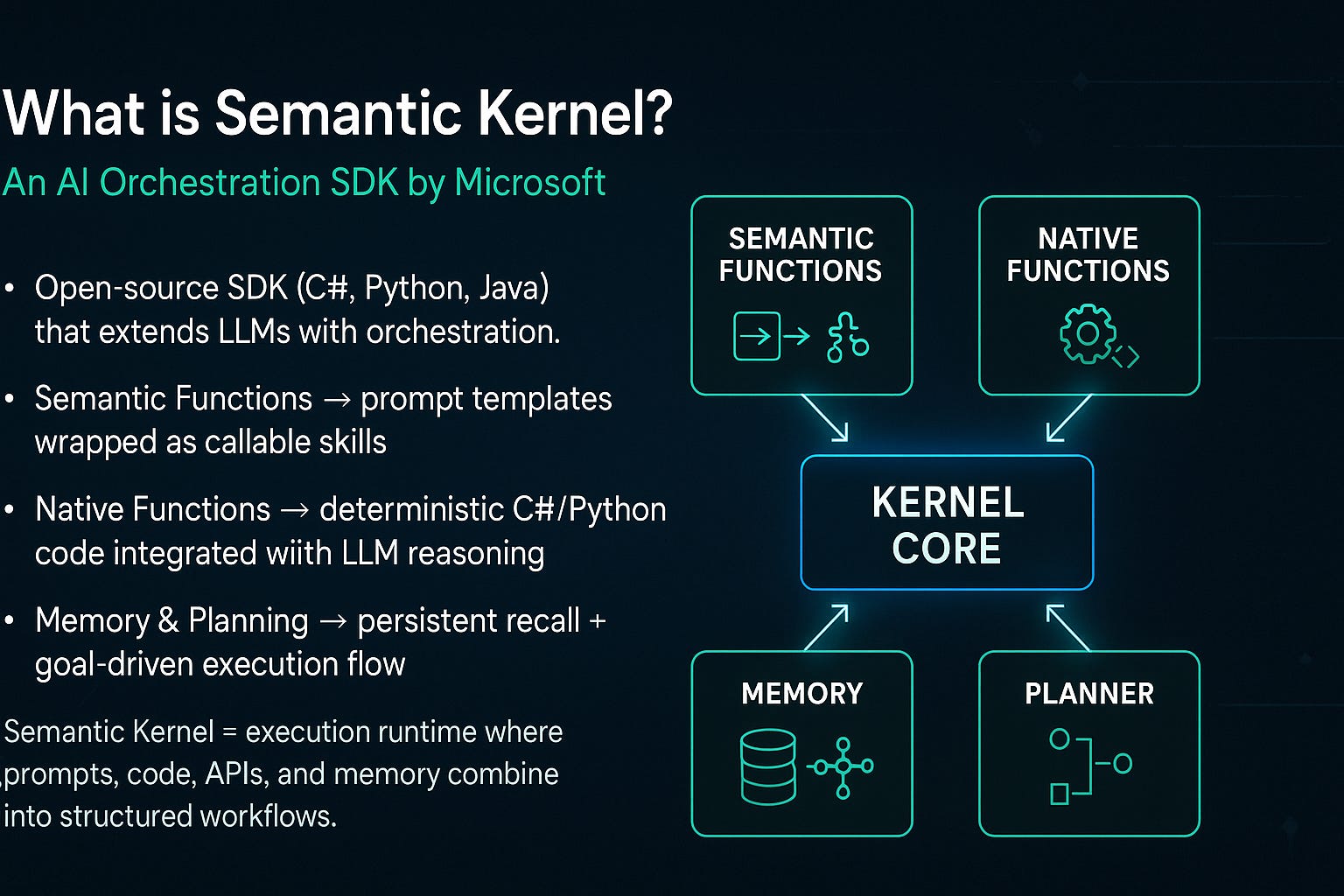
At its core, Semantic Kernel is an AI orchestration SDK that bridges LLMs, APIs, memory, and planning.
It provides:
Semantic Functions → Prompts turned into callable skills.
Native Functions → C#/Python/Java methods embedded into workflows.
Planner → Goal decomposition into multi-step task graphs.
Memory → Persistent short-term + long-term vectorized memory.
Connectors → Bridges into enterprise systems (MS Graph, SAP, Salesforce, ServiceNow, custom APIs).
In one sentence: Semantic Kernel = the middleware layer that transforms LLMs from “stateless text generators” into stateful, goal-driven agents.
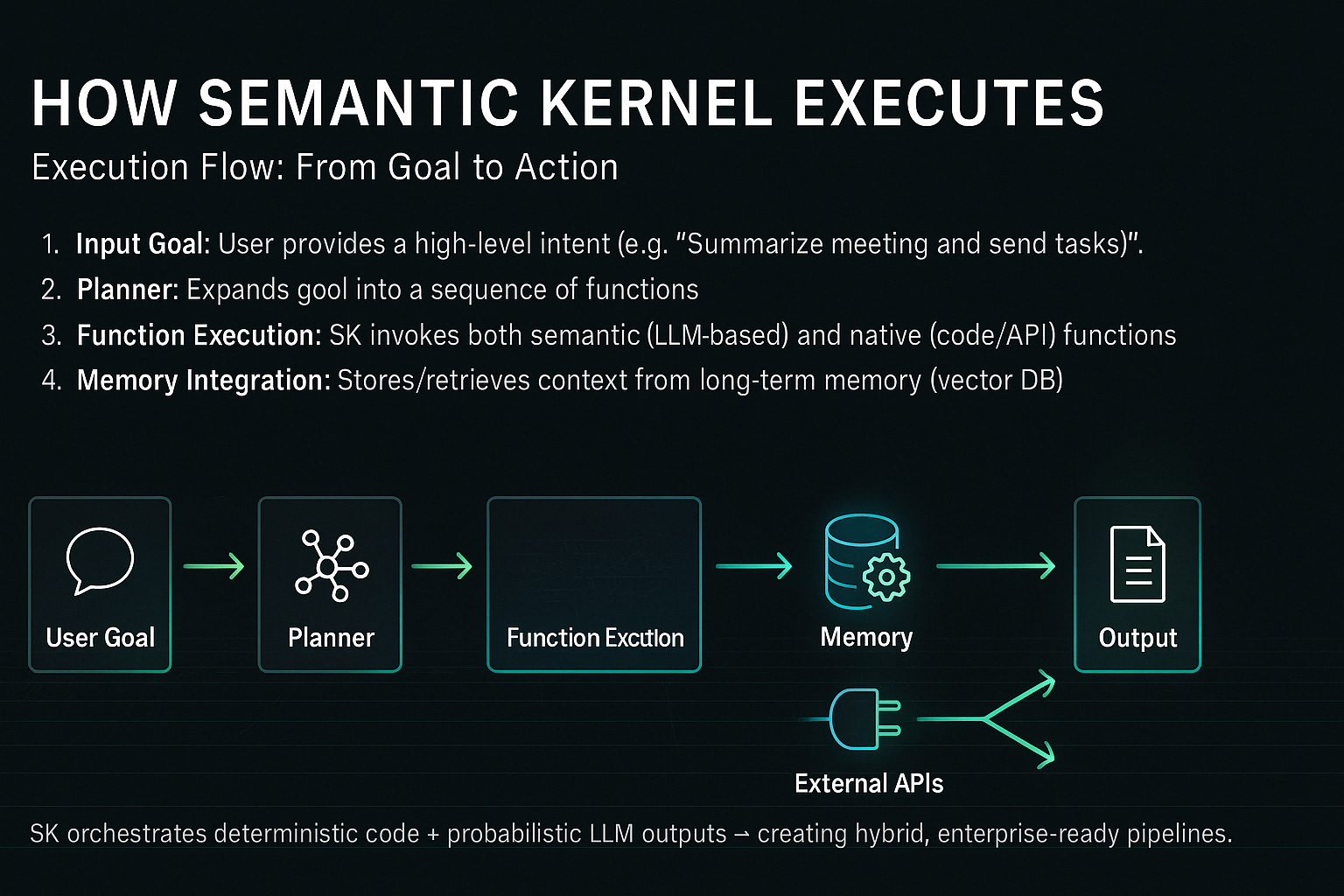
How Semantic Kernel Works: From Goal to Action
A typical execution flow looks like this:
User Goal: “Summarize today’s meeting and send action items.”
Planner: Breaks it into tasks → summarize transcript → extract tasks → schedule via Outlook.
Functions: Combines semantic + native functions to execute.
Memory: Stores results in a vector DB for long-term recall.
Output: User gets structured results + scheduled actions.
Unlike traditional LLM apps, SK handles state, orchestration, and integration, bridging deterministic code with probabilistic reasoning.
The Core Components of Semantic Kernel
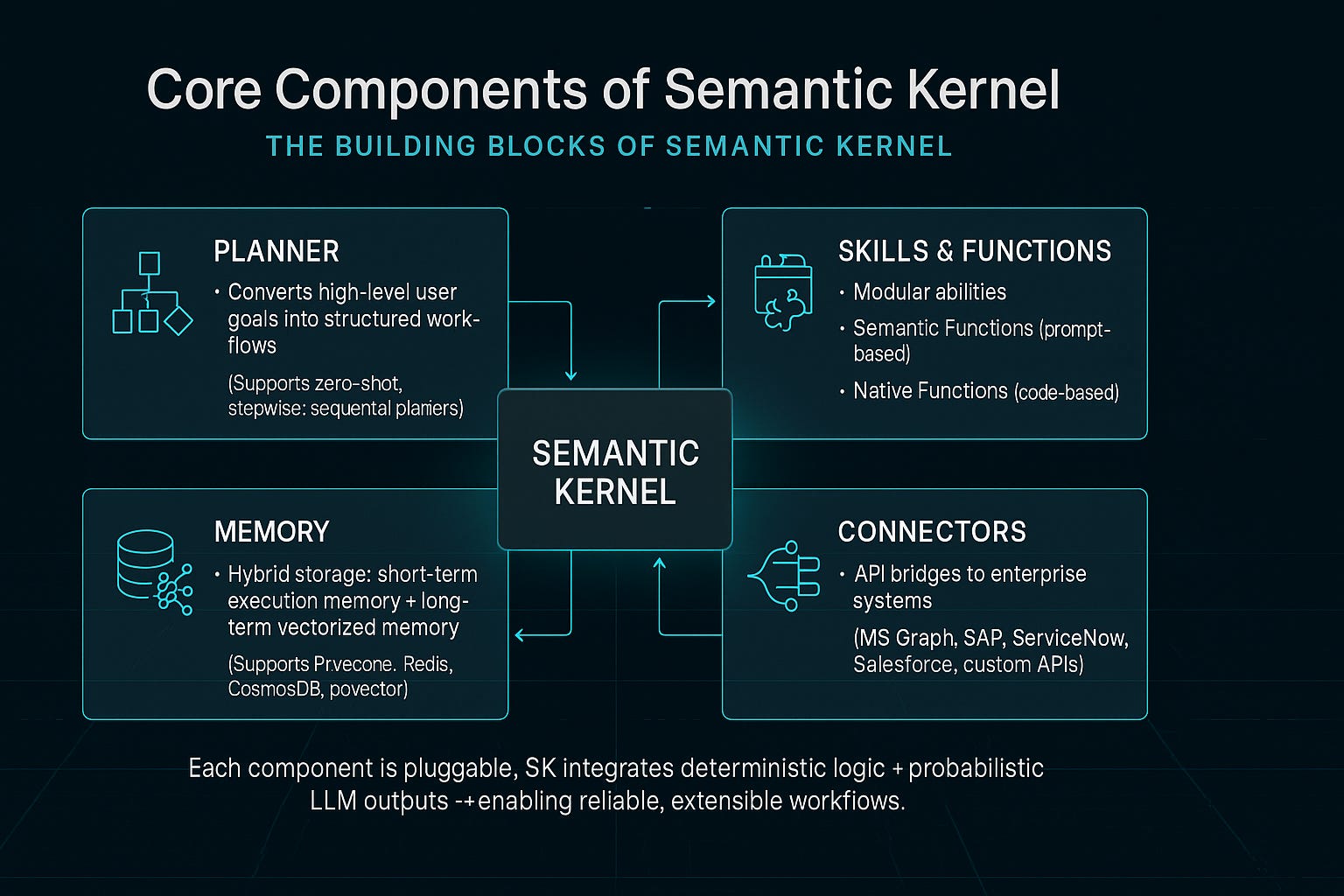
Planner → Converts high-level goals into structured workflows.
Supports zero-shot, sequential, stepwise, and even Tree-of-Thoughts planning.
Skills & Functions → Modular building blocks.
Semantic Functions (LLM prompts wrapped as skills).
Native Functions (deterministic code).
Memory → Multi-tier hybrid memory.
Short-term execution memory.
Long-term embeddings in vector DBs (Redis, Pinecone, CosmosDB, pgvector).
Connectors → Enterprise integration.
APIs for productivity (Outlook, Teams, SharePoint).
Enterprise systems (SAP, Salesforce, ServiceNow).
Together, these components create a production-ready AI runtime.
Architecture Overview (2025)
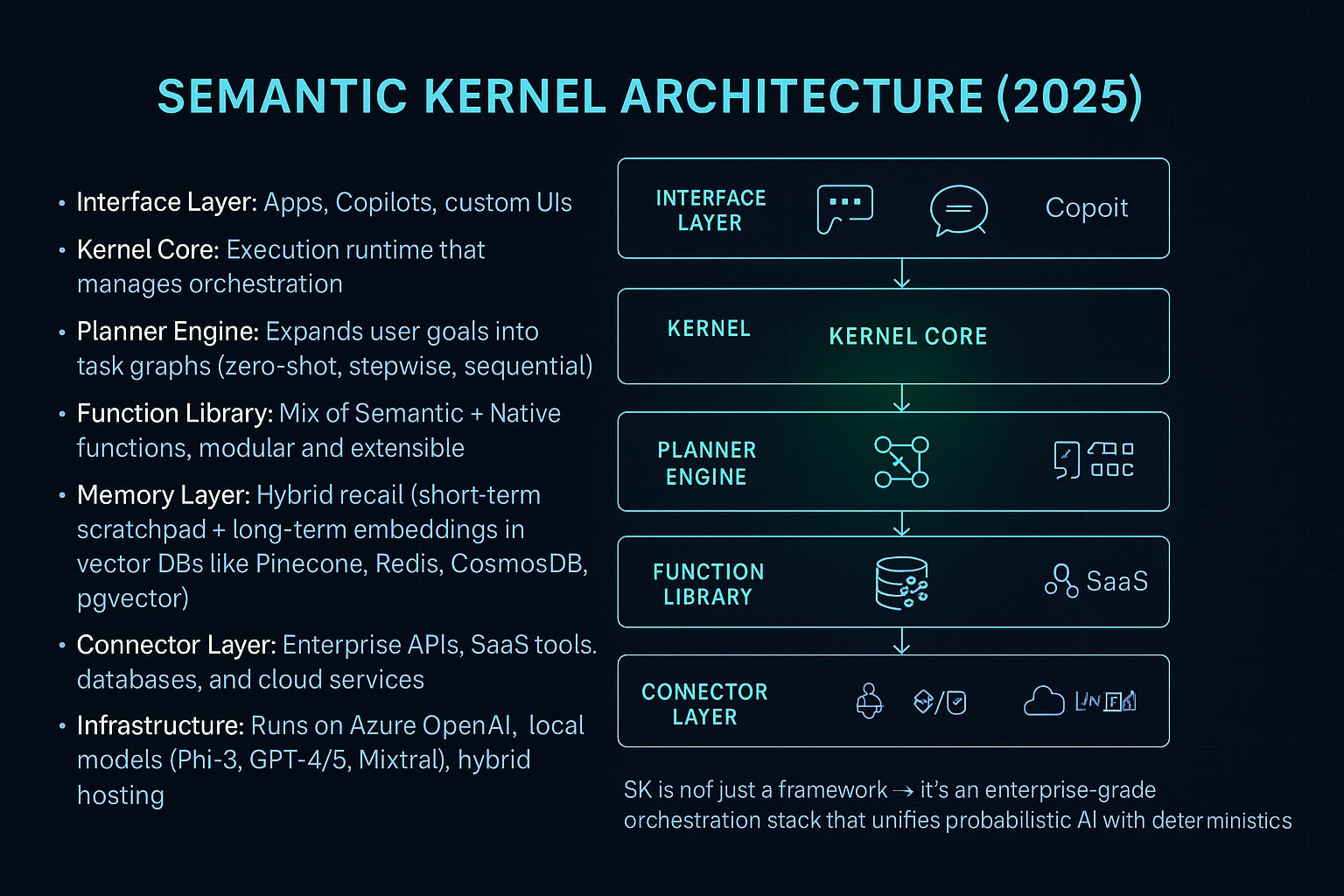
Semantic Kernel sits as a layered stack:
Interface Layer: Copilots, dashboards, UIs.
Kernel Core: Execution runtime.
Planner Engine: Goal decomposition.
Function Library: Semantic + native functions.
Memory Layer: Hybrid short/long-term storage.
Connector Layer: APIs, SaaS apps, databases.
Infrastructure: Cloud (Azure OpenAI, GPT-4/5, Phi-3), local, or hybrid hosting with Kubernetes.
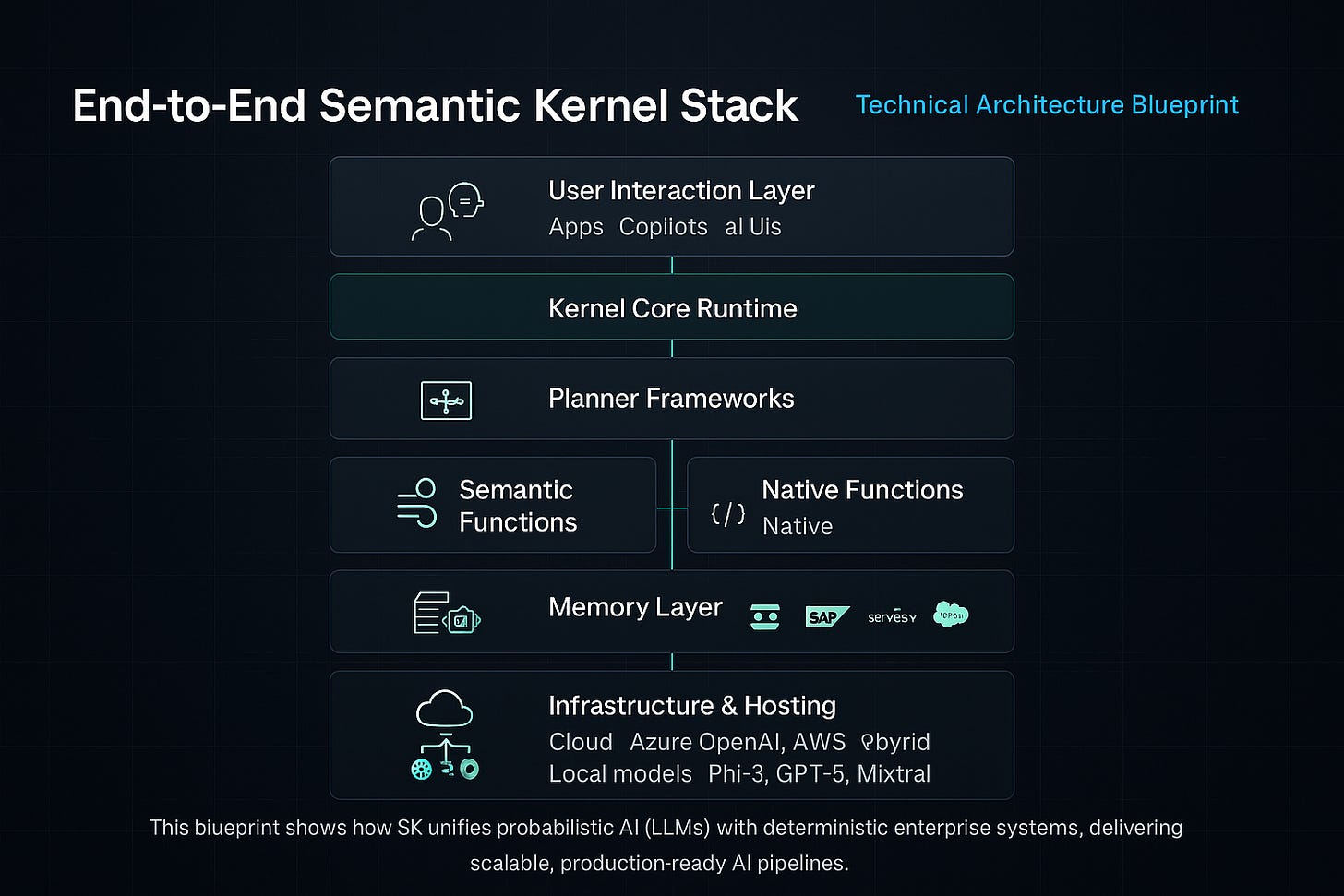
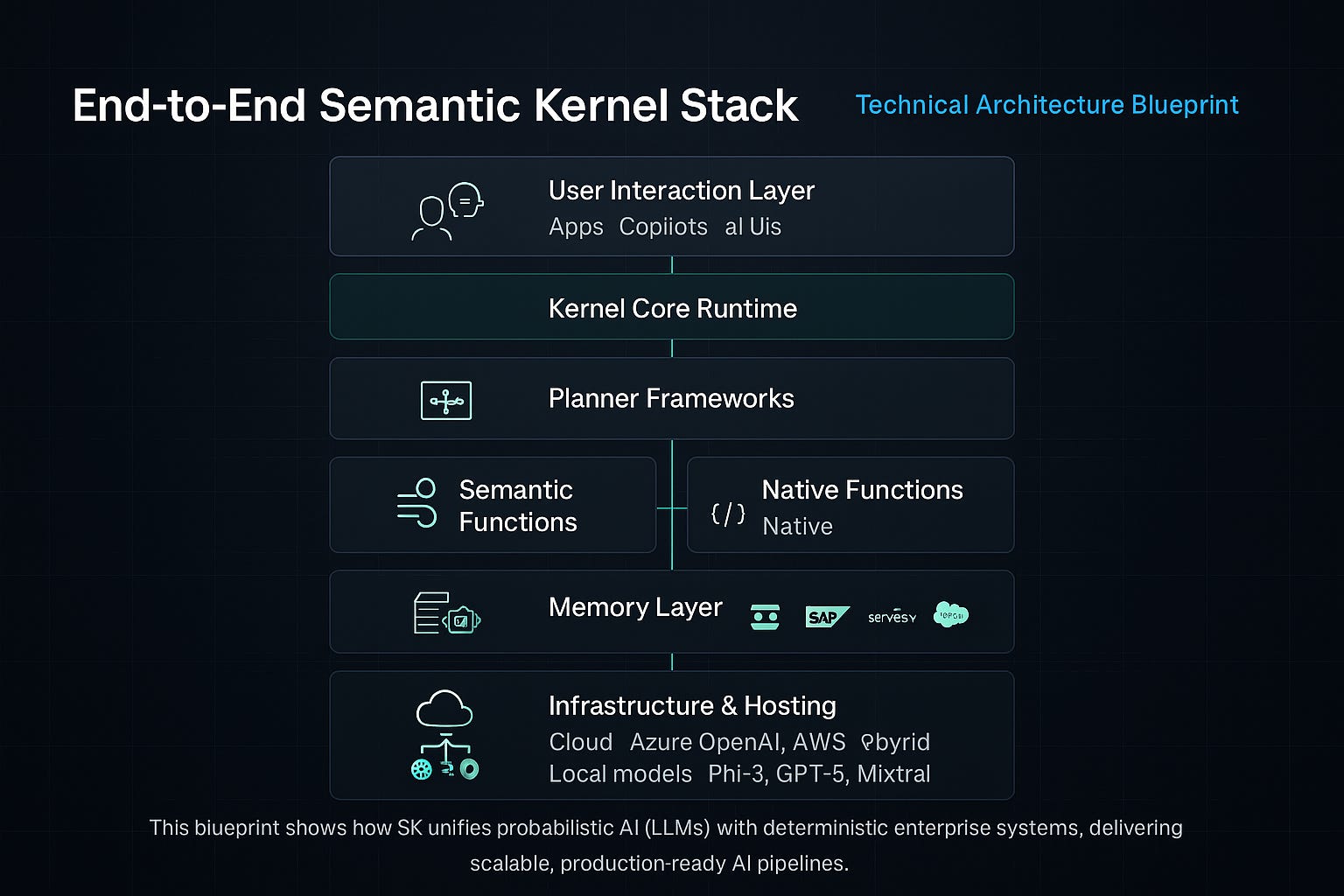
👉 Think of SK as the operating system for enterprise AI agents.
Use Cases in the Enterprise
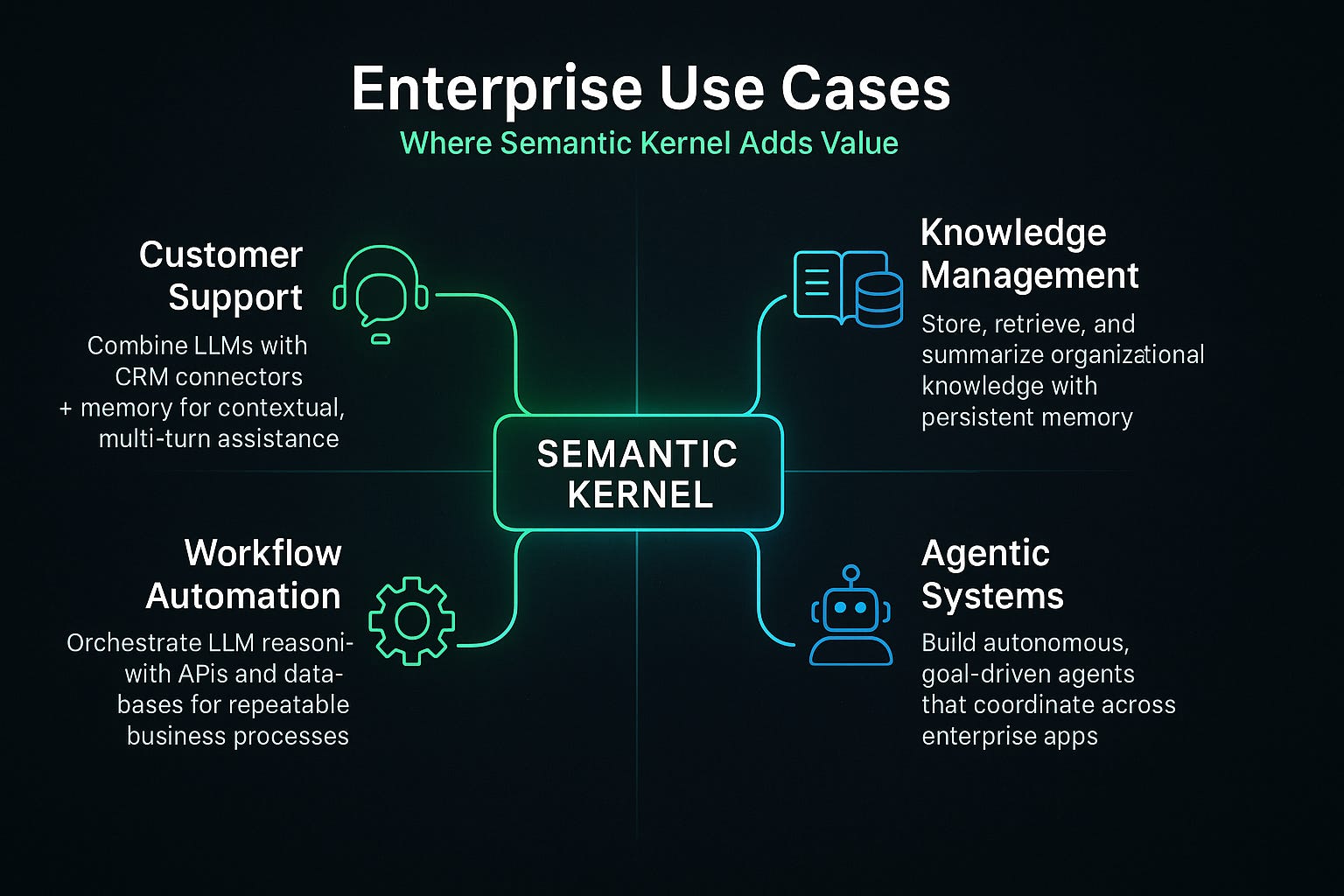
Customer Support → LLM reasoning + CRM connectors + memory for contextual multi-turn support.
Knowledge Management → Store/retrieve organizational data with long-term memory.
Workflow Automation → Automating routine, multi-step business processes.
Agentic Systems → Goal-driven autonomous agents that coordinate across apps.
Case Example: AI Meeting Assistant
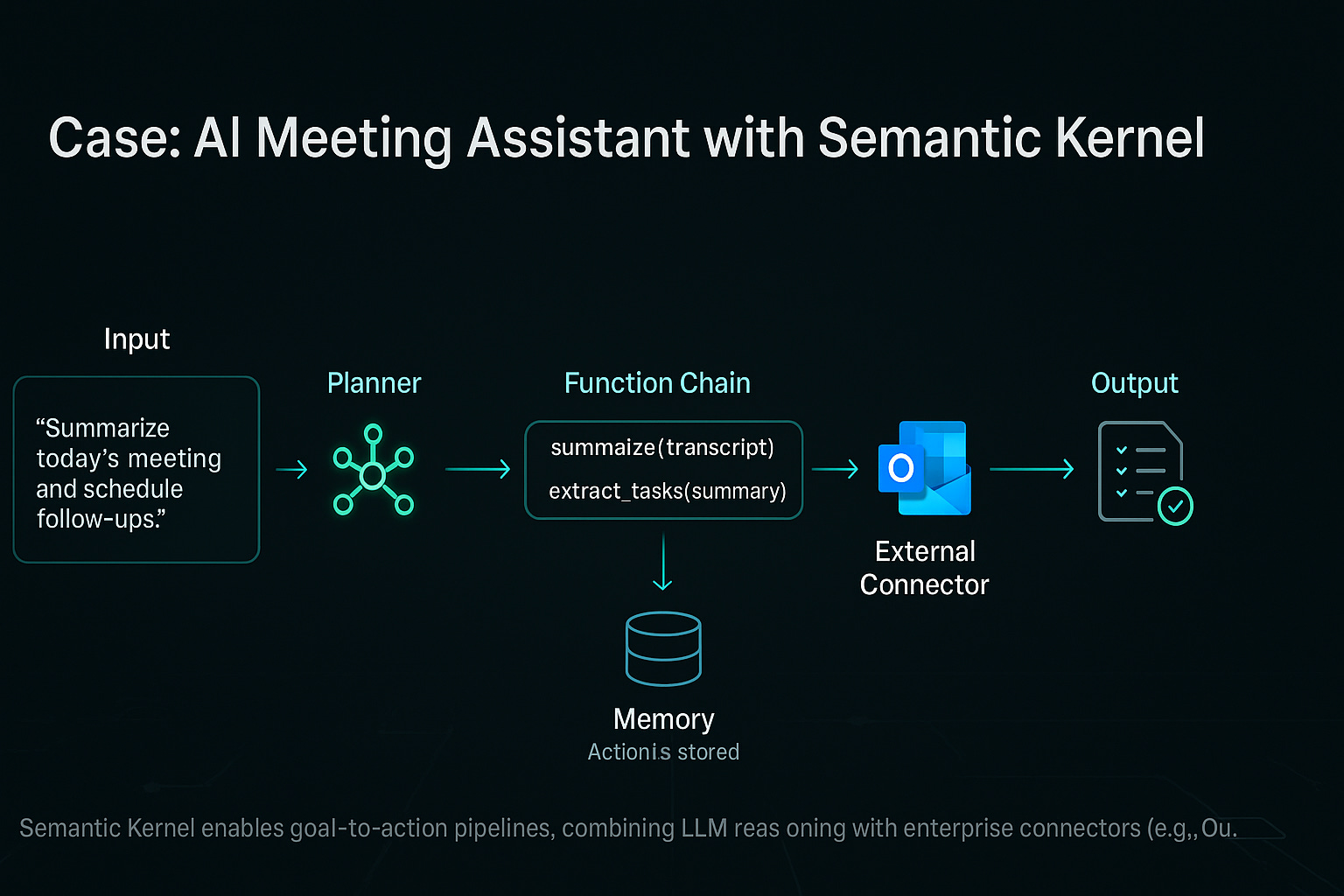
Input: Meeting transcript.
Planner: Summarize → extract tasks → schedule in Outlook.
Output: Action items + scheduled follow-ups, persisted in memory.
This is not just “chatbot intelligence” — this is workflow orchestration.
Comparison with Alternatives
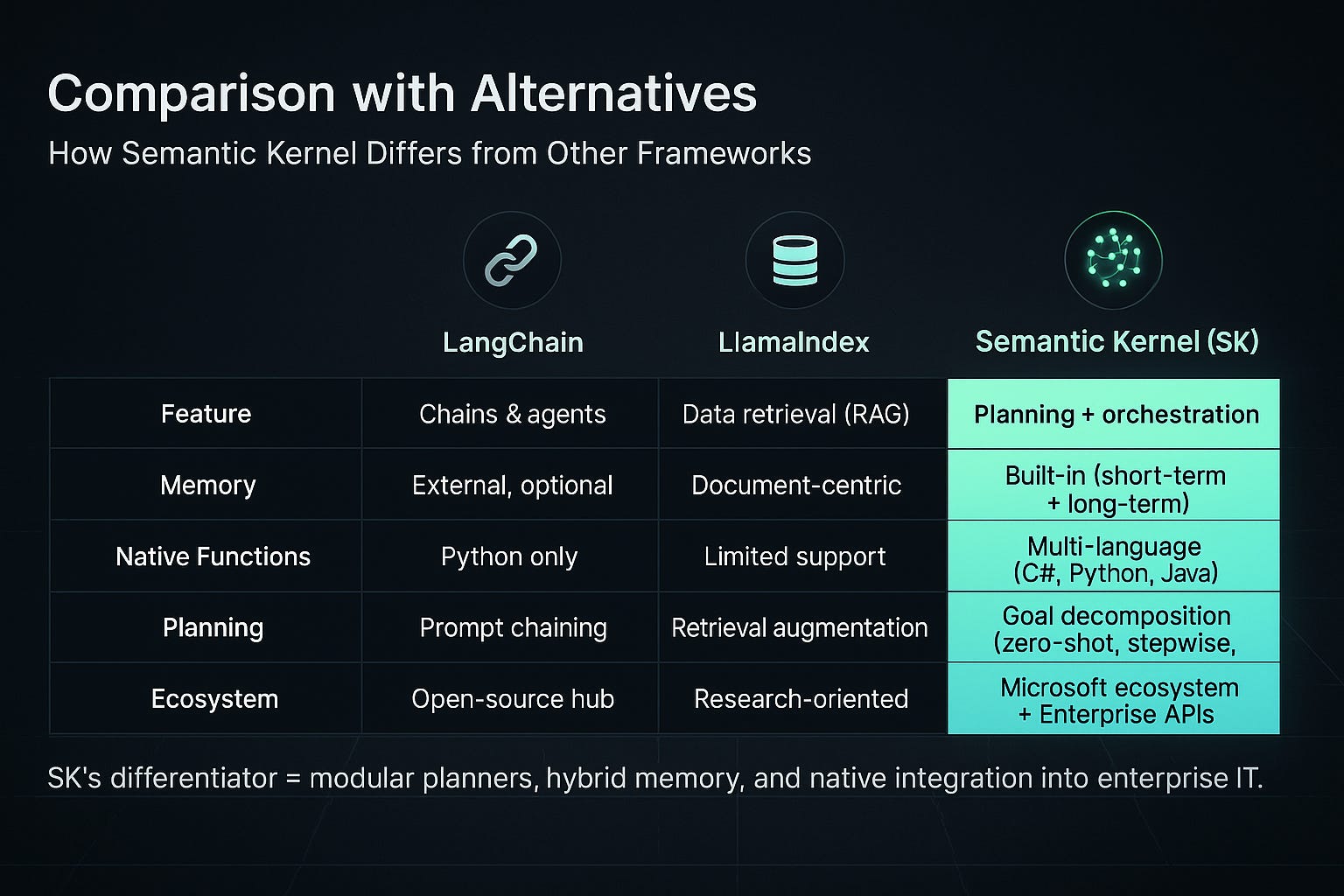
FeatureLangChainLlamaIndexSemantic Kernel (SK)Primary FocusChains & agentsData retrievalPlanning + orchestrationMemoryExternal, optionalDocument-centricBuilt-in (short + long)Native FunctionsPython onlyLimitedMulti-language SDKPlanningPrompt chainingRetrieval Aug.Goal decompositionEcosystemOpen-source hubResearch-orientedMicrosoft + Enterprise APIs
Why SK wins in enterprise contexts:
Built for Microsoft ecosystem (Graph, Outlook, SharePoint).
Natively supports multi-language SDKs.
Focused on planners + orchestration, not just chaining or retrieval.
Why This Matters Now
Semantic Kernel is not a toy project. It is the backbone of Microsoft’s Copilot ecosystem, powering:
Microsoft 365 Copilot (Word, Excel, Teams, Outlook).
Dynamics 365 Copilot.
Azure AI Agents framework.
If you’re building enterprise AI, you’re indirectly building on Semantic Kernel patterns.
Future Outlook (2025 and Beyond)
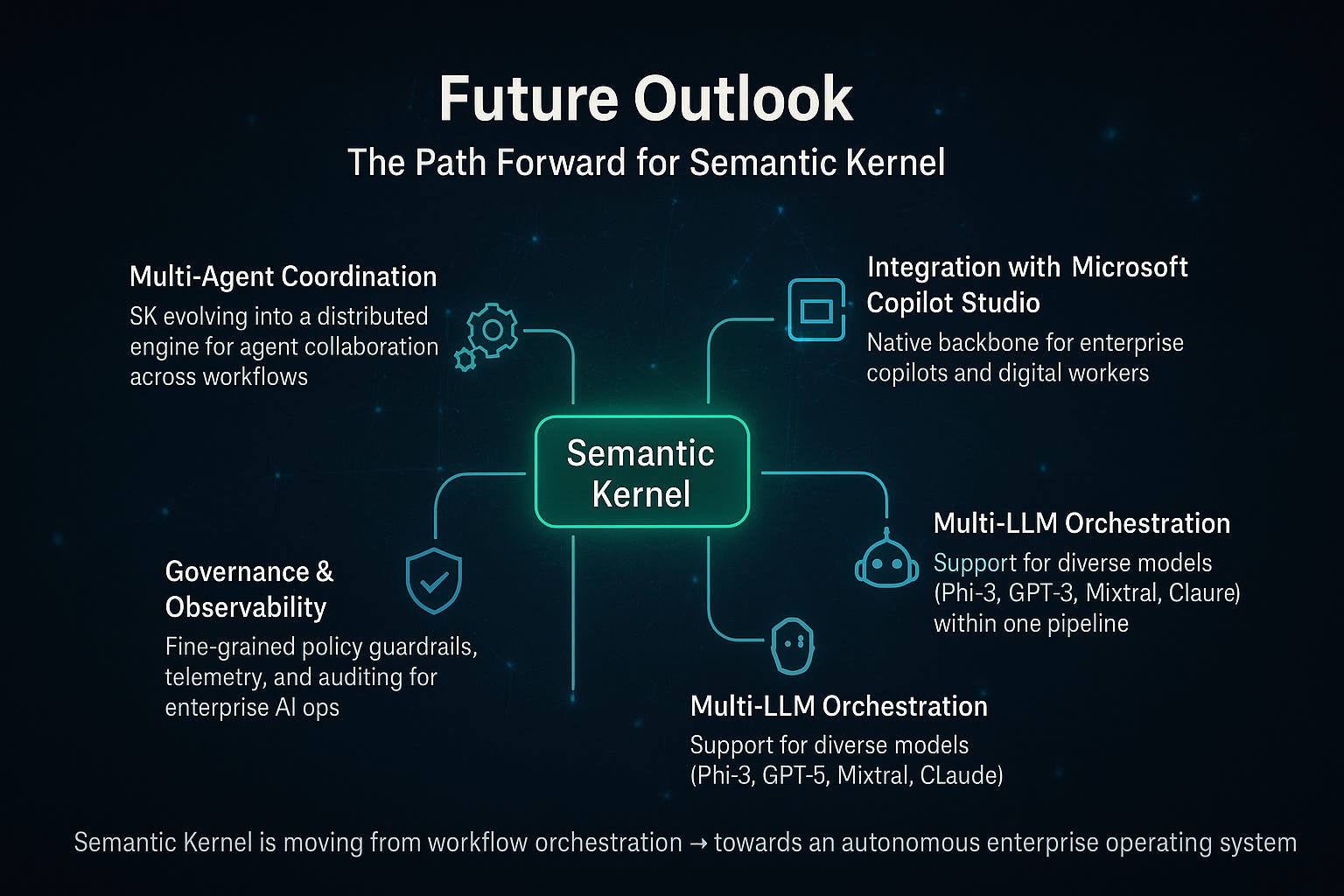
Semantic Kernel is evolving rapidly:
Multi-Agent Coordination → hub for agent collaboration.
Copilot Studio Integration → enterprise copilots built natively on SK.
Multi-LLM Orchestration → run Phi-3, GPT-5, Mixtral, Claude side-by-side.
Governance & Observability → guardrails, telemetry, compliance dashboards.
Distributed Planners → advanced planning with Tree-of-Thoughts, Monte Carlo search.
Direction of travel: From orchestration framework → to enterprise AI operating system.
Resources to Explore
Conclusion: The OS for Enterprise AI Agents
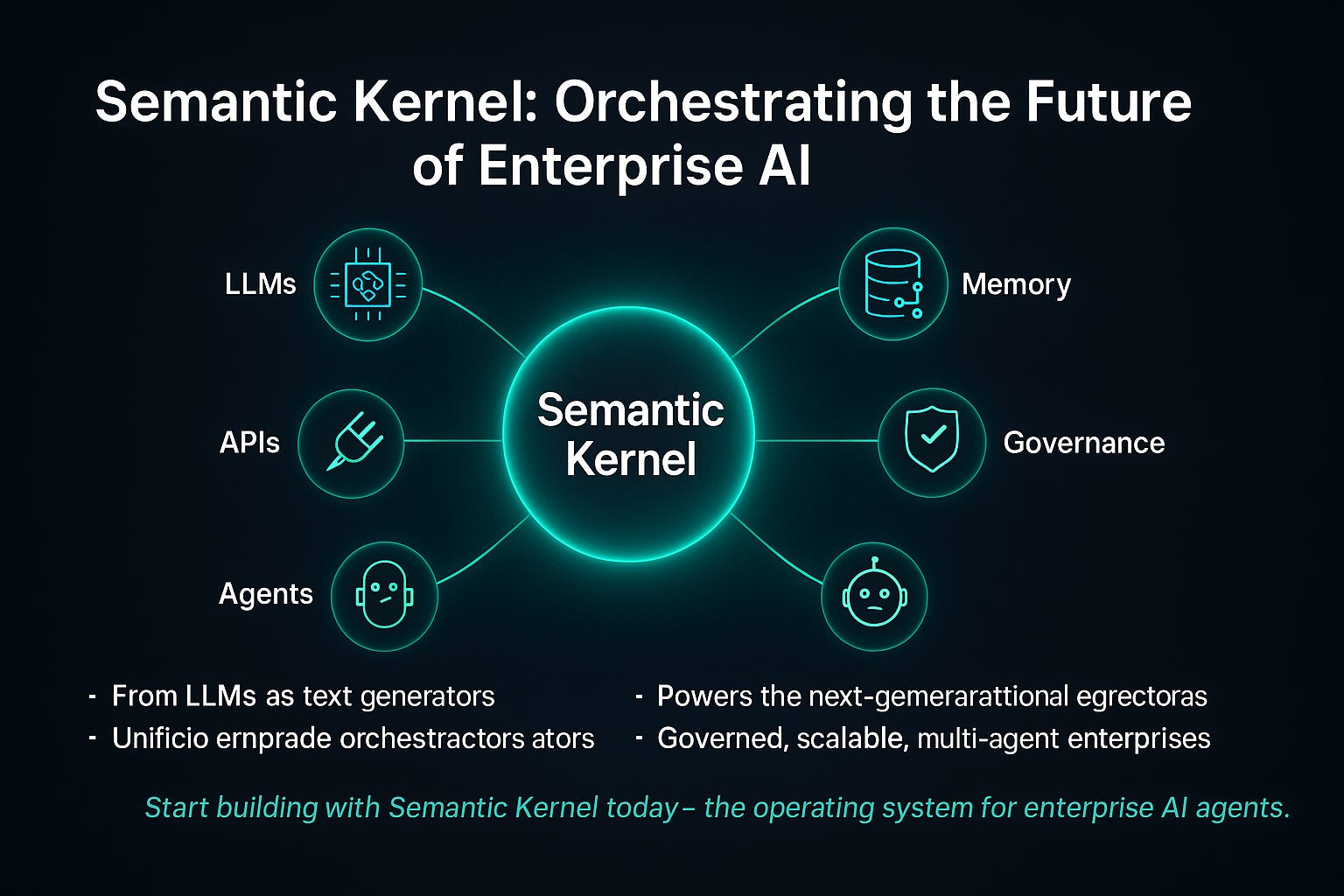
Semantic Kernel is more than a developer tool. It’s:
The bridge between LLMs and enterprise systems.
The runtime for copilots and AI workflows.
The future backbone of multi-agent enterprise AI.
The next generation of enterprise AI will not just be about talking with chatbots — it will be about autonomous workflows, governed at scale.
And Semantic Kernel is the operating system making that possible.
💡 If you’re building copilots, agent workflows, or enterprise AI integrations, start with Semantic Kernel. It’s the orchestration layer that will matter most in the next 3–5 years.